




Contents
‘[O]ur political system [...] is essentially a bazaar of legalized bribery’ - Thomas Pogge
This is one of a series of articles that I hope to compile into a book – working title, The Commoners’ Manifesto: Neither Capitalism nor Communism. Here’s an introduction to the series. Comments welcome, including disagreement and debate.
I’ve argued that anti-capitalists should reject state communism as a route to a post-capitalist world. I then looked at how states and corporations have been united since the birth of corporations, how corporations set the agenda for politicians, and how corporations get what they want via pestering and manipulation. This article covers bribery, money and the ‘revolving door’.
OK, I can’t honestly say that the practices below are bribery in the legal sense, because they’re not illegal (although they should be). But providing money and jobs for influence and favourable decisions – you decide what to call it. Not all politicians will respond positively, but enough will to skew things in a corporate direction.
Corporate money in politics
Ultra-wealthy individuals and corporations pour massive sums into political parties and election campaigns, creating dependency and expectations of favourable treatment. US election spending has exploded in recent years, from around $8 billion in 2016 to $15 billion in 2024. The vast majority of that money was spent on advertising (mostly TV ads –– hence the sound-bite politics we have today) and campaign consulting. Advertising, marketing and PR firms have moved into politics, bringing the same techniques they use to sell fizzy drinks and laundry liquid.
Political funding can buy access and influence, which can translate into favourable legislation, tax breaks, contracts or government support; but it can also help get to the front of the queue for bailouts or to avoid prosecution in case of corruption. Corporations often give to both main parties. Among corporate PACs (see below) making at least five contributions in one election cycle studied, 94% gave to candidates from both parties. The message is clear: give us what we want or we’ll fund your opponent more and you less.
Election funding used to be public and subject to limits. Candidates who accepted public funds had to stick to spending limits, while candidates who opted out could raise and spend much more, privately. In 2008, Obama became the first major-party presidential nominee to reject public financing for a general election, allowing him to raise hundreds of millions privately. Since then, the major presidential candidates have generally opted out.
Corporate funding is growing, and very profitable it is, too. Between 2007 and 2012, 200 of America’s most politically active corporations spent around $6 billion on federal lobbying and campaign contributions. In return, they received over $4 trillion in federal support (encompassing contracts, loans, subsidies and other forms of state benefits) – equivalent to $760 for every $1 spent on political influence. That’s some return. In the 2024 UK general election, political parties and campaigners spent a record £94 million, nearly 80% more than at the 2015 election. The sums involved are far smaller than in the US, but the direction is the same, and the record is unlikely to stand for long.
Politicians need expensive political consultants or they’re going nowhere. And those consultants tell them that they need to spend, spend, spend. The Johns Hopkins political science professor Adam Sheingate details this phenomenon in Building a Business of Politics (‘Most of the key decisions in contemporary campaigns are now in the hands of consultants’, and ‘The definition of public problems, the framing of issues, and the formation of interest all rely on the services of a professional political class’). Donors don’t take you seriously until you have a decent consultant.
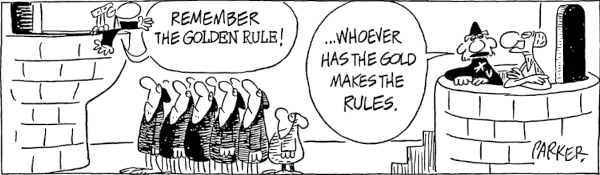
Thomas Ferguson’s 1995 work, Golden Rule: The Investment Theory of Party Competition and the Logic of Money-Driven Political Systems, is an influential resource on the subject. He argues that political change is not primarily voter-driven, but investment-driven. Major parties function as the centre-left and centre-right wings of a single ‘property party’.
As the flow of money into politics grows, its sources are becoming increasingly concentrated. According to Transparency International, ‘In 2015, only 1 per cent of private donations came from companies and individuals giving £1 million or more; by 2024, this had risen to over a third. At this rate over half of all political contributions could soon come from just a dozen or so individuals, who would account for less than 0.00002% of those eligible to donate’. Chris Harborne’s recent £45 million in donations to Reform UK would take someone on the average UK wage approximately 1,200 years to match.
Similar things happen at the local level. For example, a company such as Tesco can offer financial contributions towards local infrastructure or other community needs as part of securing planning permission for a new supermarket.
Problems
Let’s look at the problems that this causes for democracy, ideas and debating.
First, it reduces the scope of debates. Corporate political funding is often less about getting what they want and more about stopping what they don’t want. So for example, if a policy is bad for corporate profits but popular with the public (e.g. gambling limits), corporates can help keep it off the agenda, by diverting funds away from the party that adopts it. Then it’s a balancing act between parties chasing votes with popular policies, but not annoying their corporate donors too much. That can shift political debate more towards issues that don’t trouble corporations, because they don’t affect profits (e.g. around identity politics or abortion rights), and ideas that challenge corporate profits are suppressed.
Second, it also suppresses more radical ideas. The more money required to obtain political favours, the wealthier the donors must be. Wealthier donors have a vested interest in maintaining the status quo that gave them their wealth. This favours pro-corporate candidates and puts radical candidates at a disadvantage.
Third, it takes politicians away from ideas and debating altogether. Consultants are about winning, not ideas. So they will try to attack opponents’ characters, or focus on aspects of their candidate’s life that will appeal to target voters. This cynical approach has nothing to do with policies or ideas, and it means that candidates spend much more time fundraising, campaigning and mudslinging than thinking, debating and legislating.
Another huge and related conflict of interest is that politicians can own shares in companies that could be affected by the legislation and government decisions they’re involved with. Incredibly (to me, at least), although members of Congress generally have to disclose their financial interests, and are prohibited from using non-public information gained via their office for private profit, they’re not prohibited from owning stocks that could be affected by their legislative activities, and they aren’t generally required to recuse themselves from votes because of those holdings.
With the huge problems that are heading our way, we need incorruptible leaders to think deeply about the issues and debate ideas (including radical ideas) meticulously and conscientiously. Corporate money in politics gets in the way of this.
Super PACs
It gets worse. Let’s have a quick look at super PACs (political action committees), and the 2010 legal case that led to them: Citizens United v. the Federal Election Commission (FEC), in which the US Supreme Court ruled that limitations on political spending violated the First Amendment (free speech). Free speech was of course all about ‘we the people’, not about corporations. But after corporates obtained personhood, it now applies to them too.
Unlike conventional PACs, super PACs have no limits on how much they can raise and spend, but are not allowed to contribute to or be directly connected with politicians and political parties – although they can support or oppose policies or politicians/parties via TV or media ads or social media. Because they must be isolated from candidates, consultants have to sit between them. The result is unlimited contributions from corporations and billionaires, and more lucrative work for consultants.
So if a billionaire wants to give money directly to a candidate there are strict limits, but they can now give hundreds of millions to a super PAC which can spend the money helping that same candidate, and the law treats it as independent political speech.
Apart from even more corporate money in politics, downsides include huge negative advertising campaigns aimed at individuals that their opponents can disavow. It can also spark spending arms races. If your opponent is raising and spending $100 million, there will be a strong incentive for you to try to match it. All in all, it creates more conduits from concentrated wealth to our governance processes, puts the power to influence policy into fewer and fewer hands, and makes politics even nastier than it already is.
Some candidates (AOC, for example) don’t take super PAC money, but it can put them at a huge disadvantage against their rivals.
Dark money
Dark money is political spending where the identity of the original donors is not publicly disclosed. ‘Dark’ sounds shady or illegal, but it’s not. It increased significantly in the US after the rise of super PACs. They’re obliged to disclose the sources of their funding, but those sources don’t necessarily have to divulge where the funds originally came from. There may be several layers to this funding, and the more layers, the more difficult it is to discover the original source.
Dark money prevents voters from knowing who’s trying to influence them with ads, and it can hide conflicts of interest. So for example, if there’s a $100 million advertising campaign against proposed environmental legislation, the public might think very differently about it if they knew the money came from a million citizens giving $100 each, than if all of it came from an oil company. This lack of transparency means that voters can’t judge the legitimacy or otherwise of political influence.
In the UK 67% of people believe that private donations should be either banned or capped at £50,000. But who’s going to impose the cap or the ban? In a truly democratic system, there would be no private money in the political system at all – it’s obviously going to end up giving more influence, and ultimately control, to those with more money. But we can’t expect the recipients of corporate money to vote to ban it, or even reduce it. And sure enough, the UK government recently increased political spending limits by 80% (apparently, to keep up with inflation!), and political donation reporting thresholds by 50%, so we’re moving in the wrong direction.
If you want to learn more about corporate money in politics, Open Secrets is your starting point.
The revolving door
The ‘revolving door’ is the movement of personnel between government departments, regulatory bodies and the corporate sector. Politicians and civil servants leave public office to take highly-paid jobs in the industries they once regulated, while corporate executives are appointed to senior government positions. This creates a conflict of interest where officials regulate industries they plan to work for later, and corporate representatives are part of policy-making and regulation.
The same networks of people run both the state and the corporate sector, whose interests become perfectly aligned, leaving citizens and even legislators out of the picture, because they don’t really understand how the world ultimately works.
For some, this could be seen as bribery, but the bigger players are much more interested in implementing their agendas through government than in cushy jobs or inflated salaries – they have more than enough money already. But rather than continually trying to influence government from outside, corporations can place their own people inside it. However, when the door revolves the other way, and a politician accepts a corporate job, it can involve a huge increase in salary. Incredibly, around half of all US senators and one third of congress members take corporate jobs on retirement, including with lobby firms.
Although mainly a Western phenomenon, the door revolves in Western vassal states too. Many West Asian oil monarchies have energy ministers (‘their excellencies’) who are or have been CEOs of energy companies (although these tend to be state-owned in that part of the world), like Saudi Arabia’s Khalid al-Falih, who went from CEO of Saudi Aramco to Minister of Energy, while Qatar’s Saad al-Kaabi has simultaneously served as Energy Minister and CEO of QatarEnergy.
There are many more examples globally, involving corporations and their associated institutions. A particularly striking statistic is that in 2012, 20% of finance ministers in the 47 African countries receiving World Bank assistance had previously worked for the World Bank or IMF. Peter Lawrence argues that this creates a revolving door through which corporate-friendly policies are imported into national governments. And although the centre-left in the UK have come to believe that the EU is some sort of paragon of virtue, in fact it’s a pit of vipers just like all its national governments. Again, too many examples to mention, but a classic of the genre was former EU president Jose Manuel Barroso, who later joined Goldman Sachs (see below) as a non-executive chairman.
Problems
The main criticisms are about conflicts of interest – corporate vs public. Rather than exposing these conflicts, we’ve moved in the direction of making the corporate interest appear as if it is the public interest, using all the techniques I outlined previously. The worldviews at the top of the corporate and political worlds merge; so where’s the oversight? Not in the executive branch, which is more-and-more corporate, and not in the legislature, where members can’t really regulate things they don’t completely understand, especially with much better-informed corporate elites constantly pressuring, pestering, bribing and threatening them.
Researchers found that firms hiring senior officials from economy ministries receive significantly higher volumes of government loans in subsequent years (Trevor Incerti, How firms, bureaucrats and ministries benefit from the revolving door: evidence from Japan, American Political Science Review, 2025). But individuals don’t need to be corrupt. They just interpret their regulatory role through the lens of the industry culture they absorbed and will return to. Yes, if they make decisions that are favourable to a particular industry, they’ll have better prospects of getting a lucrative job in that industry later. But that’s for small fish. Bigger fish have an agenda, an ideology. They want to make sure that governments don’t get any ideas about legislating in ways that harm the corporate sector as a whole. That’s not seen as corruption if it doesn’t benefit a particular corporation or individual.
Here’s more on possibly the biggest fish (or maybe squid) of all:
The ‘vampire squid’: Goldman Sachs
Let’s have a look at how just one corporation makes use of the revolving door: Goldman Sachs, subject of the now famous 2010 vampire squid article by Matt Taibbi in Rolling Stone. It’s a similar story with many other giant banks, but the GS story is truly remarkable. I’m not sure that any other corporation has ever had such global political influence. Here are some well-known examples (although there are many more):
Robert Rubin spent 26 years at Goldman and became one of its two senior partners in 1990. He then went into the Clinton administration, becoming chairman of the National Economic Council and subsequently US treasury secretary.
Hank Paulson became Goldman’s sole chairman and CEO in 1999. In 2006 he left GS to become US treasury secretary under George W Bush, where he played a central role in organising the bank bailouts during the 2008 financial crisis.
Mark Carney worked at Goldman Sachs from 1990 to 2004, becoming a managing director in 2002. He subsequently became governor of the Bank of Canada, governor of the Bank of England and prime minister of Canada.
Steven Mnuchin worked for GS for 17 years, eventually rising to CIO (Chief Information Officer). In February 2017, he became US treasury secretary, serving throughout Trump’s first presidency until January 2021.
Mario Draghi went from government to Goldman and back again. He was director-general of the Italian treasury until 2001, before becoming managing director of Goldman Sachs International in 2002, responsible for working with governments and government agencies as well as major European corporations. He became governor of the Bank of Italy in 2005, president of the European Central Bank in 2011 and prime minister of Italy in 2021.
Robert Zoellick revolved even more than Draghi. Between 1985 and 2013 he went from senior positions in the US treasury, state department and White House to senior GS advisor, deputy secretary of state, GS vice-chairman, president of the World Bank and then back to GS as chairman of its international advisors.
Joshua Bolten flitted between senior US government and GS positions before becoming White House chief of staff under George W Bush.
Stephen Friedman became co-chairman of GS with Robert Rubin in 1990, and then under George W Bush he became assistant to the president for economic policy, director of the National Economic Council, chairman of the President’s Foreign Intelligence Advisory Board and chairman of the Federal Reserve Bank of New York (while still holding his GS position).
I’m getting bored with this now, but you get the idea. Look up other Goldman alumni like Gary Gensler, John Whitehead, Malcolm Turnbull (who became Australian prime minister), and dozens of others who went on to occupy some of the most powerful positions in government and international institutions.
None of them necessarily delivered any benefit directly to Goldman Sachs. In fact, ex vice-chairman of Goldman International, Bob Hormats, challenged anyone to find anything that any of these people had done in office that benefitted Goldman directly. But that’s not the point; it’s about allowing the banking sector to self-regulate, and preventing the state from doing anything to harm corporations.
For example, after the 2008 crash, Paulson oversaw the government’s $700 billion TARP bank bailout programme, including about $245 billion in capital injections in more than 700 banks. In my opinion, it would have been much better to have distributed that money to small businesses and allowed the banks to die, but that would have been anathema to Paulson, whose priority was to preserve the corporate financial system. And of course it doesn’t work the other way around – we’ll never get any handouts from the banks when they’re in profit — it’s always a case of ‘heads they win, tails we lose’.
One more: Rubin advocated for ending Glass-Steagall (separating commercial and investment banking) while treasury secretary. Citicorp merged with Travelers Group to form Citigroup in 1998, in anticipation of a change in the law, which indeed happened in 1999. That same year, Rubin left the Clinton administration and joined Citigroup as a senior executive, and made $126 million over the next 8 years. So yes, the revolving door helps make personal fortunes, but that’s still not the main point for these people, I don’t think. They want power, not money.

This is an ongoing story. Keep up to date by searching for banks and revolving door. And it’s not just the banks. The same story can be found in all sectors, and especially in oil and tech. But one particular revolving door is scarier than most.
Warmongering & surveillance
Palantir is a software company with deep roots in the US military and intelligence world. It has a strategic partnership with Israel’s ‘defence’ ministry, and NATO uses its Maven software for its Allied Command Operations. Its technology can make multiple, previously separate sources of information on individuals connected, interoperable and searchable, which hugely increases the state’s ability to surveil and track us. Palantir is a company for which war and surveillance is very, very profitable. So the last thing we’d want is for a revolving door to exist between this company and our public institutions and government, or for it to have access to everyone’s sensitive personal information, right?
Well, that’s not how the world works any more. The UK government awarded Palantir a £330 million contract to build the NHS’s federated data platform; so the company that built systems for ICE deportations and military/intelligence organisations has become deeply embedded in Britain’s health-data infrastructure. And of course the revolving door is in operation. Laurence Lee, for example, was a senior Ministry of Defence (MoD) official who helped write the military’s AI strategy, and subsequently joined Palantir. Investigations have identified this as part of a much broader movement of UK public officials into the company. As I write, Palantir has UK government contracts worth hundreds of millions of pounds, across 10 departments, but mainly the MoD and NHS.
This is where the revolving door becomes an existential threat for humanity. As Jeffrey Sachs explains: ‘Wall Street, military contractors, Silicon Valley, and Big Oil control American foreign policy to maximise elite wealth and access to global resources, supply chains, and strategic choke points.’ I think ‘American’ is misleading however, as the empire isn’t geographic, and has nothing to do with the American people; but the US state is certainly central to the empire, and he’s right that American foreign policy ensures almost permanent war, which is extremely profitable for the corporate sector – particularly banking, weaponry, tech and oil (the US has had only 17 war-free years in its 250-year history).
The revolving door swings both ways. As well as corporations employing government ministers and public officials, the state provides top jobs for corporate leaders. The scariest examples of this involve weapons manufacturers being given top defence jobs – and sometimes right at the top. It doesn’t matter which party is in power. Trump appointed Mark Esper, a former Raytheon lobbyist, as US defence secretary, but Biden went further by giving the job to Lloyd Austin, an ex-Raytheon Technologies director. What chance is there of global peace with a revolving door between weapons manufacturers and the top of the US defence department?
Conclusion
There are many, many more examples of all the above, and the fact that it’s all legal should make people give up on the electoral system as a vehicle for the changes we need. But it doesn’t, unfortunately, which is why we need commons.
So far in this series, I’ve looked at how the communist state is not the way to challenge corporate dominance, and how ‘democratic’ states have been captured by corporate interests, via think tanks, the funding of education, media ownership, astroturfing, social connections, lobbying, regulatory capture, donations and the revolving door.
In the next article, I’ll look at how the corporate sector threatens and punishes governments in order to get its way, and I’ll summarise the ways that corporations capture states. After that, I’ll look at what corporations get in return from their captured states. I’ll argue that Western states are part of the corporate empire, and are therefore not at all a useful tool for challenging it.
Dave, your depth of research and setting all this out is awesome, and makes the whole story very convincing. I was wondering about GS, asked Google "does Goldman Sachs have any Israeli government connections" and received a very clear: "Yes, Goldman Sachs maintains significant financial and advisory connections to the Israeli state and market." Which makes me wonder even more... Perhaps you've all seen this YouTube channel: https://www.youtube.com/@oliviaswing but I found her latest deeply moving: https://www.youtube.com/watch?v=8tmeyUV9AU0 a tale of how Charlie Kirk was compromised, and then assassinated, with what looks like a blatantly political motivation. It's the depth of the analysis, the careful and persuasive piecing together of the evidence, that she shares with you. And she has excellent analysis of lots to do with Epstein. So … you cover the financial side very nicely, with GS; Olivia Swing documenting the nefarious actions of the so-called "christian" right covers the (im)moral side—focusing more on power than plain money. Though of course they go together. Hand in glove. All pointing in very similar directions. Feels to me … well … horrifying.