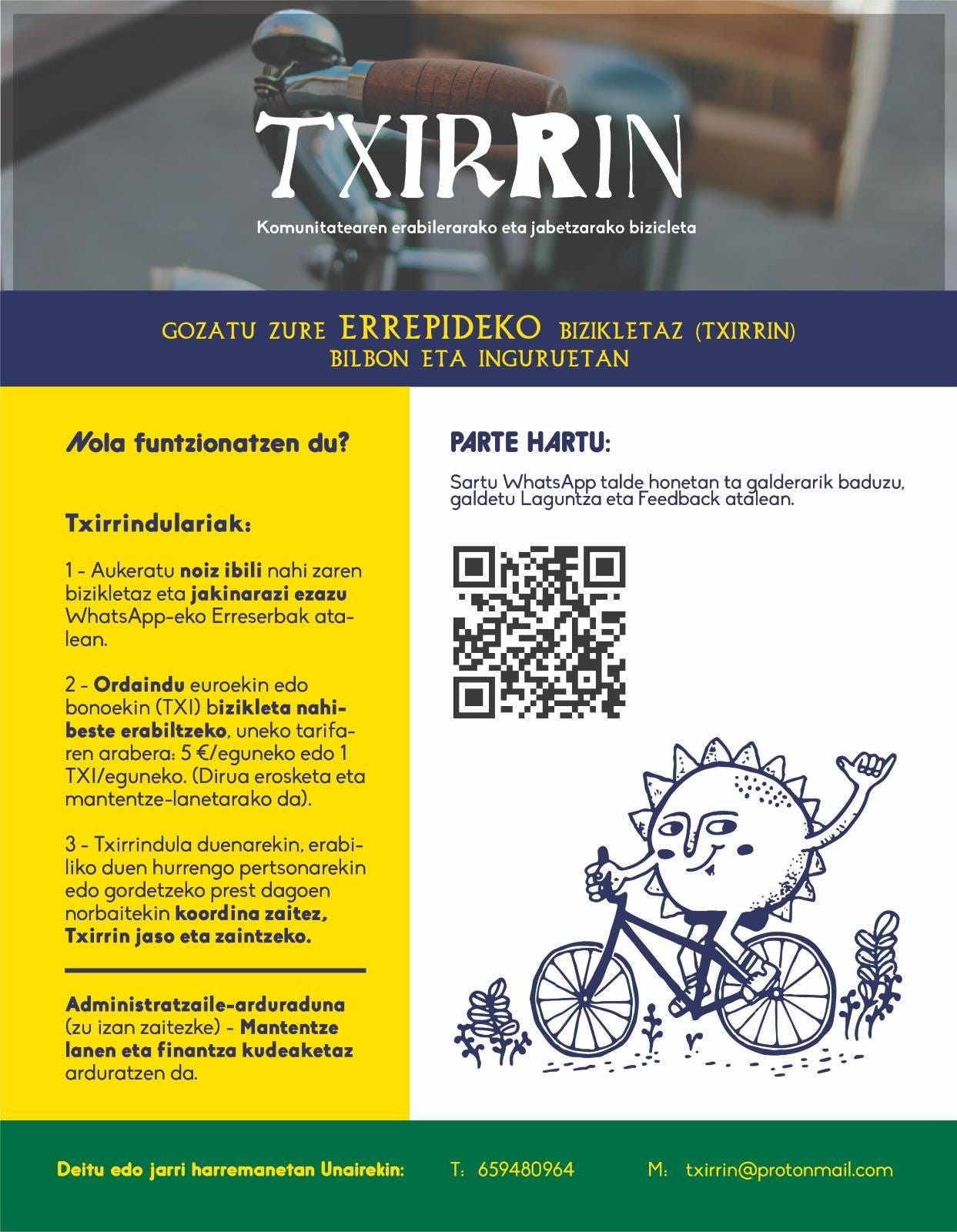

This is an interview with Unai Gaztelu of Txirrin (pronounced ‘chirrin’) - a group looking to launch a housing commons project in the Basque country, but first, they’re practising with bicycles and cars!
Below is a video of our conversation, followed by a summary in bullet points (with links to more info), and then the complete transcript.
Summary
Unai’s team is looking to launch a housing commons in the Basque Country.
They’re using the use-credit obligations idea, developed by Chris Cook, Dil Green and Mutual Credit Services.
They’re practising first with bicycles, then cars, before moving on to houses.
They’re using consent decision-making, based on sociocracy.
Investors, customers and employees (who administer the scheme and maintain the bicycles) are all full members.
They are creating an association that complies with all state regulations.
They will also have a trusted ‘custodian’ or ‘guardian’ member with a veto vote, so that assets are not lost from the commons. This member may even be an organisation, that will provide an ‘asset lock’ for several commons organisations.
Vouchers are denominated in days of use of a bicycle.
Vouchers are held in an app called ‘Citizen Wallet’.
They’re happy to connect with others wanting to do similar things - txirrin@protonmail.com
Full transcript
Dave: Today, I’m talking with Unai Gaztelu, who’s in the Basque country and is a member of several coops there. He’s also part of a group looking to launch a housing commons project in the Basque country, but first, his group is going to practice with bicycles and cars. Hi, Unai.
Unai: Hi, Dave. Great to be here with you.
Dave: The first thing I wanted to say is that I’ll put links to more information about the tools and models you’re using in the description. But before we talk about what you’re doing exactly, I want to talk about why you’re doing it. What’s the problem you’re trying to solve? What’s your motivation?
Unai: I would say I can explain it from two sides. The more pessimistic one is that I would like to increase the freedom that we humans live with. That’s the same as reducing the domination of humans over other humans or over nature, so that we can basically live with peace, harmony, doing things from love. That would be the positive way of framing things. Imagining us living together and doing things from love, from a positive place of optimism and love to nature and to others.
Dave: We’re a long way from that.
Unai: As a systemic level, yes. But then I see a lot of love, harmony, and compassion at the small level, in relationships, friends, family. So it depends on where you look.
Dave: I think humans are basically nice, but we have a system that pushes people to do things that are not nice.
Unai: Yes. There is this Otto Scharmer quote: “We collectively create results that nobody wants.” That might be true.
Dave: So tell us a bit about your background. What did you study?
Unai: I studied environmental engineering, about ten or fifteen years ago. But I don’t consider myself an engineer. Maybe I have the mindset, but I never really practised it or was interested in practising it. I started with environmental engineering because I was concerned about what we are doing to planet Earth. That was my main concern, not so much the social aspect of domination over other humans. From there, I started to think about and practice different ways of changing that, and that’s how I got to know different ideas, practices, and ways of being that we can maybe talk about.
Dave: As I understand it, your idea is you issue and sell vouchers for future use of a bicycle. With the money from selling the vouchers, you buy the bicycle. Is that the basic idea?
Unai: Yes, that’s the idea. We don’t only buy it, but we repair it. The one we got was a bit drastic, so we put it in perfect condition. We also budgeted for components like oil, a pump, some repairs, and spare parts. But that’s the basic idea.
Dave: That simple idea can be used for lots of things: bicycles, cars, houses, energy infrastructure, land, leisure centers, pubs. Vouchers for use of a resource sold at a discount, and the discount makes it worth people’s while to buy them.
Unai: Exactly. I really like this. There’s an article by Dil Green where he mentions a breach, talking about the transition from feudalism to capitalism. It’s a very contested topic with ongoing debate and no clear answer, but one simplification is how the people who had power gave it away. In a way, I see what we are talking about as creating obligations as a mechanism to do that. It offers people who are in power now, or those who have capital, a way to put their capital to work. They get more capital out of it, but what’s happening in the background is that we are growing the commons—bringing resources under the commons. It’s a kind of hack, from my perspective.
Dave: I know the article. A Transcender Manifesto. How did you come across the idea?
Unai: I’ve been following the work of Chris Cook, Mutual Credit Services, and similar people for a while. At the same time, my family and I are part of a group that wants to live in a shared house, a cohousing project. Having these two things together, I thought it would be worth trying to implement the housing commons model here in the Basque country. I started talking with different people, and that’s how we ended up here.
Dave: So ultimately, you’re looking to start a housing commons. But practising with a bicycle is a genius idea. Can I ask for more details about your project? What kind of bike is it, and how many do you have?
Unai: So far, only one. We are demand-driven. We want as many bicycles as people need, not the other way around. My cousin Eduardo, who is now a member and my partner in developing these ideas, and I both like cycling and have done tours in Spain and France. A third friend had a spare racing bicycle. We saw it as a nice opportunity to experiment with this model for housing commons. We decided to treat the owner of the bicycle as an investor. We issued vouchers and exchanged them for the bicycle and for euros from other investors.
Dave: So the person who donated the bicycle got vouchers?
Unai: He gave them to our friend, who was looking for someone to take the bike. But yes, they became an investor. They now own vouchers, and they are not necessarily users—they are investors.
Dave: Some people who own the vouchers are just investors. They might sell the vouchers to people who want to use the bike, but they don’t want to use it themselves.
Unai: Exactly.
Dave: Same with housing. Investors can hold housing vouchers as an investment, not to house themselves, but maybe as part of their pension.
Unai: Exactly. I know you guys are exploring that option of pension funds holding use-credits, and I think it’s brilliant.
Dave: The free bicycle aspect might happen with houses too. Older people with no kids might leave their house to the commons in exchange for vouchers, with a clause allowing them to live there for the rest of their life.
Unai: Definitely. My parents own a house. If I inherit it, I would put it into the commons. I hope I can convince them to do it while they are alive. They could continue living there, pay with credits if they want, but make sure the house is owned by the commons and can remain affordable for whoever needs it.
Dave: You know your house will do something good after you’re gone, and for the rest of your life, maintenance is not your problem—it’s the commons. Maybe we could also offer a package where people who put their house into the commons get some care, not professional care, but people coming to check on them and have a chat.
Unai: Yes. Care credits are an option. Chris Cook mentions how older people often have money but lack care, while young people have no assets but can provide care. There’s a match there.
Dave: Younger people have plenty of time and nowhere to live. Older people need care and have too much house.
Unai: Exactly. Perfect fit.
Dave: How many vouchers did you sell, and how did you work that out?
Unai: We made some calculations. First, we budgeted. We needed to raise €400 to pay for the bicycle repair and some tools. We checked the market price for renting such a bike but wanted it to be affordable. We decided on €5 per day. A local association rents bicycles for that price; others rent for €20 per day, but those are for-profit and maybe better bikes. We also wanted investors to get a return relatively soon with numbers that make sense. We estimated demand based on the usage it already had, since a bicycle isn’t like a house with constant demand. With these parameters, we set €5 per day and issued around 80 vouchers. Investors could get about a 10% return in maybe four years. It was a decent investment.
Dave: Did the investors become full members of the group?
Unai: Yes, definitely. That’s part of how it works. We are in the process of registering it legally as an association. The members will be the users—the cyclists—and the administrator, who is currently my cousin, taking care of the bicycle and the finances.
Dave: That’s the same as for houses. You need to maintain the houses and administer the scheme.
Unai: There’s a difference between a bicycle and a house. A bicycle probably needs more frequent maintenance. The margins are different, so we are learning as we practice. But it’s the same model. Investors are part of the commons, and we also have a Guardian figure, a person or organization with veto rights.
Dave: You’re doing that as well. That’s very interesting.
Unai: We are prototyping it, testing it. We are developing our bylaws, and the goal is to have them accepted by the state. We are trying to frame them in a way compatible with their requirements while ensuring that we are all together—investors and the commons. We want the Guardian to have veto rights, so we are encoding that legally. We are also using consent decision-making, based on sociocracy.
Dave: So you’re going full-on with custodian, member classes, and sociocracy. That’s proper.
Unai: Yes. And we are already practising even though it’s not legally registered. Making collective decisions through consent is part of the process. We had our first decision a couple of months ago, and it’s fun. Having lower stakes with a bicycle allows us to make mistakes. For example, we could test if someone tries to steal or sell the bicycle to see if our bylaws are good enough to protect it. We would only lose a bicycle. We are doing this slowly, steadily, and trying to enjoy it.
Dave: So you have meetings with investors, users, stewards, and the Guardian with veto power. How do you choose your Guardian?
Unai: We haven’t done that yet, but we’ve had conversations. When you think about ways people could hack it and sell the assets, you realize that the first Guardian is a key person. It needs to be someone we truly trust. We thought of Chris Cook, though he lives in another jurisdiction. Another interesting option is to choose an organization. We are in touch with people in Galicia who are working on locking assets under the commons by creating a second-order organization that holds veto power for many different commons. We haven’t decided yet; we will decide sociocratically.
Dave: It’s genius to work out all these things in a low-stakes system. If the bicycle is stolen, it’s just a bicycle. Then you can move on to a car next?
Unai: Yes. The bicycle doesn’t legally have a registered owner—the state doesn’t care. But a car is different; they care about who owns it. We want to do a car next. We are already looking into it, but we have a small issue with ownership and a parking spot. But we definitely want to do it with a car and add the feature of legal registration under the state.
Dave: When you get to houses, you’ll have a lot of experience under your belt.
Unai: Yes. In our case, we don’t yet have the connections or capacity to attract people for a house project. In Stroud, you went all in with a house, which is great if you can. But for people like us who are learning, this is a nice option.
Dave: We’re learning too, but the stakes are higher. What are your bicycle vouchers denominated in?
Unai: One day of bicycle use. If it were a different type of bike, like one for daily commuting, we might denominate it monthly. But for this racing bike, people use it for day tours, so we denominate it in days.
Dave: Do you print vouchers, or is it on an app?
Unai: We use Citizen Wallet, a simple app that uses blockchain technology in the background. It’s not so important now, but it might be if the group grows and trust becomes an issue. You download it, and if you buy vouchers, you can send euros to our shared account or pay with cash, and we issue the vouchers. In the app, you see your balance and can send or receive vouchers. When you use the bike, you pay with vouchers to the commons. To buy or sell vouchers, you just ask for the other person’s username and send them.
Dave: Who built the app?
Unai: It’s an off-the-shelf app. I collaborate with the project—Citizen Wallet—and they are very nice people.
Dave: Where is the bike kept? How do people get it?
Unai: Currently, the last person to use the bike keeps it at home in a safe place. We communicate on a WhatsApp group with different channels. One channel is for booking. If someone wants to use the bike, they say so in the group. The person who has it responds, and they agree on how to transfer it. If someone has trouble storing it, Eduardo, our administrator, usually keeps it.
Dave: This is a practice run, but do you have ambitions for more bikes?
Unai: If there’s demand, why not? But we don’t want to push things. As a commons, we decide what to invest in next. If there’s demand, we will. A friend, Alex, who works with a local currency, pushes us to aim for a large float of maybe hundreds of bicycles. He says that if we have 100 bicycles, people will take notice. But I’m not personally excited about that—managing that many bikes could become an issue. I’d rather try it with other resources that bring new features, like a car. I was in Barcelona recently and discovered a cooking machine that cooks for many people efficiently. It costs €5,000, but meals can be as cheap as €2-3. That could be another future project.
Dave: If you had hundreds of bikes, voucher sales and investments could generate income to pay stewards to maintain them.
Unai: Yes, that’s the idea. Scale definitely helps for that.
Dave: How is your group legally structured, and what’s the name?
Unai: It’s “Txirrin.” (pronounced chirrin) In Basque, bicycle is “txirrindula,” and “txirrin” is the sound of the bell. We liked it. Legally, we are not yet registered, but we want to try as an association. Some people suggest foundations are better for holding assets and ensuring they can’t be sold, so we are connecting with different people to learn what best fits our needs.
Dave: How autonomous is the Basque country? Are you looking at Basque or Spanish law?
Unai: I think it’s Spain. You register at offices in the Basque country, but once registered, the association works across Spain under Spanish rules.
Dave: Do you see yourself ultimately at the center of a large housing commons in the Basque country?
Unai: Of course. That’s why we’re doing this. My cousin Eduardo takes on strange challenges. When I told him I wanted to do something like this with him, he said, “We’re already doing it. Challenging the current housing market and the perception of property is the biggest challenge you can think of.” So, yes, we have that ambition. But we are realistic and take it slowly. We haven’t got any funding, and we’re still discussing whether we want it or not.
Dave: You can plant seeds. As things change, ‘realistic’ changes too.
Unai: Yes. I don’t know how things will turn out, but I trust this. We want to keep playing, experimenting, testing, and hope to include other collaborative finance tools like mutual credit. But slowly.
Dave: We’re building a commons lab in Stroud to research and develop playbooks for various commons models, including housing commons. You’re welcome to have the playbook when it’s ready. You might be ahead of us. We’d love to document the growth of housing commons in other countries. There’s potential to connect all these projects and federate to a global scale.
Unai: I hope to see it, or at least we are trying.
Dave: People could replicate your bicycle project. Do you have any documentation on how you did it?
Unai: Not super well documented. We have some documents explaining our steps, but if people are interested, we would love to talk with them. That’s part of why we are doing this—to connect with people with the same ideas and goals, maybe under different names and strategies. We are definitely inviting others to replicate, support us, or make small experiments with these ideas.
Dave: Any other background information you’d like to add?
Unai: No, nothing comes to mind.
Dave: Who would you like to see interviewed, and why?
Unai: I’d like to hear more from Chris Cook. Also people involved in traditional commons—that’s super interesting. There are many possible threads and conversations.
Dave: I’d like to keep in touch and learn from your discoveries.
Unai: Happy to do so.
Dave: Can people keep up with what you’re doing? Do you have a website or blog?
Unai: We are not publicly sharing much online. We have an email: txirrin@protonmail.com. People can write to us. We also have a WhatsApp group for practical use. If someone wants to see what’s going on, I don’t have objections, but we’d have to ask the rest.
Dave: Do you have any photographs?
Unai: Yes, we have a channel in our WhatsApp group where people share pictures.
Dave: Maybe I can get a few for the article.
Unai: Sure. Txirrin was at the Tour de France last summer.
Dave: I’ll put links to everything in the description. It’s been great talking with you.
Unai: Likewise.
Dave: Are you coming to the Festival of Commoning in October?
Unai: I’ve never been, but I was planning to. I hope so.
Dave: You’d be very welcome. Lovely speaking with you. Hopefully, we’ll talk again soon.
Unai: Thanks a lot.
Dave: Cheers, Unai.
Unai: Cheers. Bye bye.