

Collaborative Finance (CoFi): rethinking finance for the commons
What finance looks like when communities build and govern it themselves


This article is adapted and expanded from a knowledge base entry written by Matthew Slater. The Growing the Commons knowledge base is a community-curated collection of concepts, projects, and ideas related to commons-based approaches and systems change.
We have preserved much of Matthew’s original language and argument while adding editorial context, a short introduction to Collaborative Finance and its underlying principles, selected examples, and a fuller invitation to the upcoming CoFi4 gathering in Austria (21-28 June 2026).
Why traditional finance goes awry
The commons movement is a backlash to the idea of private property, in which ownership of land and other assets is exclusive, which gradually splits society into classes of owners and of the dispossessed. But ownership is just a part of the problem.
Collaborative Finance addresses another dimension of the problem, which is how the money and financial system puts the state, its institutions and its plutocrats between people struggling to make a living, skimming and confiscating their resources at every turn.
Let’s consider some common, even essential, financial instruments:
Insurance
Pensions and unemployment benefits
Loans and mortgages
Saving and investment
Payments
The smooth and fair operation of these mechanisms is critical because their failure ruins lives. Stringent regulation helps to protect against fraud and failure, but also to obstruct small players and innovators. Maybe this is fair – when it comes to risk management, the larger institutions can juggle more assets and cope with larger hazards.
But this also leads to the financial sector being owned and run exclusively by the ruling class. Those elites can evade these regulations because they can afford specialist accountants and access tax havens. The products and tools are arcane and difficult for the government to regulate. Revolving doors, corruption and other mechanisms compromise the regulatory system. Despite all the government protection, violent speculative cycles, scams and abuses still happen, and justice fails to catch up. The largest institutions are often the most prolific criminals, and in some ways hold sway over government itself.
Meanwhile, for most of us, the financial services we use have become like indifferent machines: algorithms decide if we are creditworthy; our pensions are used to finance polluting industries and war-criminal governments; we struggle to keep our data from predators and time-wasters. We watch all the money slipping through our fingers and being collected in enormous pools which overflow with riches we may never enjoy.
What if?
Being organised at such a large scale ensures that only remote rich people design these systems and derive all the secondary benefits. But what if there was a more appropriate scale, in which trust actually played a role, in which profit was not the prime directive but was ploughed back into the system? In which the people taking risks helped to manage those risks?
What if the so-called free market had space for small-scale financial services – like house and car insurance in every street? What if pensions were managed by the local government which, after all, is the main provider of elderly care? What if we could invest in the very businesses that produce and sell our necessities, as a way of ensuring our own security? What if those businesses turned around and invested in us, making our security mutual? And what if this myriad of local human financial organisations could de-risk through voluntary federation?
One of the first assumptions we need to unpack is about the role of money itself, the thing that integrates all our activities with the dominant financial machine and makes each of us part of the problem. Money is really good for standardising accounting, taxation and fines, but it is quite hard to obtain and hold on to. Maybe if we could enter into different kinds of financial relationships, we could find other ways to settle debt, to account for exchange, and to provide for the future.
Because money, it turns out, is not where finance begins. Finance precedes money. Long before banks, markets, or coins, people pooled resources, shared risks, settled obligations, and invested together in a common future.
What is Collaborative Finance?
Collaborative Finance, often shortened to CoFi, is not a single organisation, technology, ideology, or mechanism. It is an emerging field and community of practice exploring how communities can create, run, and govern their own financial systems, services, currencies, and instruments – collaboratively, and for themselves.
That one idea stretches across all the major financial functions: not just exchange and payments, but also saving, lending, credit, insurance, and investment. What unites them under a single umbrella is a shared answer to one question: who finance is by and for. In CoFi, the answer is the community itself – the people who actually use the system.
The motivations vary. Sometimes the aim is to reduce dependence on scarce cash, letting members trade even when money is tight. Sometimes it is to keep value circulating locally instead of leaking away to distant shareholders. Sometimes it is to give smaller players the bargaining power that comes from acting together, to share risks that no one could carry alone, or to finance the things that banks and governments will not.
Many of the approaches explored within CoFi are far from new. They draw on practices that are often centuries old and found the world over (see What does CoFi look like in practice? below for specific examples). What is genuinely new is the opportunity to connect these traditions across countries and sectors, to learn from one another, and to build shared tools using recent technological advances.
What makes CoFi different?
Mainstream finance is optimised to maximise profit for the owners by maximising revenue from the customers, at least as far as the cartel allows. The benefits of doing it another way, then, are everything but maximal revenue! Instead finance done collaboratively between peers should be less fearful, more flexible and less legalistic; more fun, more participative, more considerate of the environment and community. It should build social bonds and provide more non-monetary and serendipitous returns.
Several principles recur across the field:
It treats money as a social relation, not a commodity or thing: when we treat money as an object, we forget that it is always, at bottom, based on social agreement – a negotiable relationship of credit, trust, and obligation. The question is not what tokens circulate, but what relationships and responsibilities sit behind them. CoFi also prioritises money’s role as a means of exchange – keeping value moving through a community – over its role as a store of value to be accumulated.
It serves the real economy: the point is not to create assets for speculation, but to support the people and organisations producing real goods, services, care, infrastructure, and ecological value.
It treats trust as something to be nurtured, not eliminated: some technologies try to make finance “trustless.” CoFi does the opposite, seeing trust as the solid foundation on which effective finance can be built. It leverages the trust that already exists between people who know one another, then devises ways to extend and reinforce it over time.
It assumes different tools serve different purposes: a mechanism designed for local exchange tends to be unsuitable for long-term savings and community funding. CoFi therefore doesn’t seek a single universal solution, but promotes a plural ecosystem of interacting tools, instruments, mechanisms and services, each serving a specific purpose.
It scales not through consolidation, but federation: CoFi starts with individual communities – often small, usually grassroots. Scale comes not from one network absorbing the rest, but from many independent, self-governing systems choosing to connect and interact on shared terms. Each stays sovereign over its own rules, but expands its reach through federation.
Put simply, collaboration comes before finance. Financial tools can support cooperation, but they cannot substitute for it. Communities need relationships, trust and shared purpose before any mechanism can succeed.
What does CoFi look like in practice?
CoFi takes many forms. Most practitioners are less attached to any one mechanism than to the question of how these approaches can complement one another to support resilient local economies. Some of the main families are:
Mutual credit: participants extend each other credit within a network, trading even when cash is short, with the network itself acting as the source of liquidity. This family includes Local Exchange Trading Systems (LETS), time banks, and business-to-business barter exchanges. Examples include Sardex in Sardinia, the government-supported Fureai kippu care-time system in Japan, and the global Community Exchange System (CES).
Community and local currencies: money designed to circulate within a particular place or community, often with additional social and environmental goals. Examples include Brazil’s Banco Palmas and its social currency, the Palmas (now part of a network of over a hundred community banks), and the Chiemgauer regional currency in Germany.
Multilateral clearing: businesses cancel out what they owe one another within a network, settling only the net balance and freeing up scarce cash. Examples include Local Loop Merseyside in Liverpool and the global Cycles network.
Voucher and use-credit systems: businesses or producers finance themselves by issuing prepaid vouchers that can be redeemed against their own future goods or services. Classic cases are Deli Dollars and Berkshire Farm Preserve Notes in Massachusetts, USA.
Savings circles and rotating credit associations (ROSCAs): members pool their money and take turns drawing on the pot, under rules they set themselves. Examples include kin.coop in the UK and the Sarafu Network in Kenya (which combines several mechanisms including mutual credit and community currencies).
Community investment: residents collectively finance shared assets such as housing, renewable energy, shops, or pubs, keeping ownership and returns local. In the UK alone, for example, community shares have funded hundreds of such projects over the last two decades.
Mutual insurance: participants collectively share risks among themselves rather than outsourcing them entirely to commercial insurers, much as the original friendly societies and tontines once did.
What can I do?
Finance is always a shared activity – you can’t do it on your own! But you can start by deprogramming yourself from deep cultural indoctrination. Reflect on what these words really mean:
Money is a means, not an end in itself.
Value is what you value, not the market.
Work is the creation of wealth for yourself or for your community.
Wealth is not the balance of your bank account but the quality of your life, your health and your relationships.
Security is emotional and relational, not just physical or material.
With this grounding you can work with others to create wealth and security together. Building large-scale, trustworthy institutions from scratch takes years or even decades of patience, yet commoners have achieved it many times before. Building societies took hold and thrived amongst the urban poor of the Industrial Revolution; savings pools can be found in nearly all the monetised societies of the world; the Mondragon Coop still dominates a whole region of Spain.
But we also have to be realistic about the obstacles. Most people are very conservative with their money and the incumbent system is the devil they know: it is more or less predictable, and highly efficient. By contrast, collaborative finance is often built around potentially less familiar assets and relationships. A young CoFi initiative has many ways to fail and potentially lose its members’ assets. For this reason it is important not to put all one’s eggs in a single CoFi basket.
There is also a lot of churn in this field. Many projects fail to get off the ground, often for governance or personality problems, and if successful, there is always the danger of being co-opted and the temptation to sell out. The other great challenge is finding each other and building real, trusting relationships. The people who are awake to the menace of the financial system are thinly spread, often use different language for similar ideas (or vice versa), and don’t always recognise each other as natural allies. This makes it harder for them to meet, to associate, to build trust and to develop lasting institutions.
So building a more collaborative financial system can only happen gradually, cautiously, even if you feel the need for it painfully urgently. And even if you never fully achieve the ideal, the process itself should be immensely valuable for building trust and community around you.
Join us at the CoFi 4 gathering in Austria (21–28 June 2026)
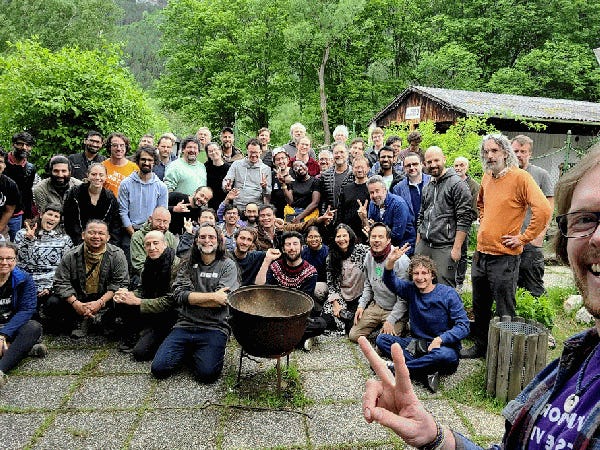
CoFi is also a thriving community! Every summer, people from across the field gather in the picturesque Austrian Alps to meet, compare notes, and build bridges – between community-currency practitioners and technologists, between monetary theory and local practice, between people who have spent decades on alternative exchange and those arriving from newer fields such as Web3, regenerative finance, and network science.
Matthew describes the spirit and rhythm of these gatherings as follows:
First, we talk – a lot – and learn from each other; often we realise we are describing the same thing in different words. Then we help each other in little ways. Then, sometimes, we do projects together.
CoFi4, the fourth gathering, runs 21–28 June 2026 at Commons Hub Austria, in Hirschwang an der Rax, at the foot of the Alps. It is less a typical conference than an intimate, week-long community retreat combining structured sessions and open space with shared meals, walks, and time in nature – set in a former countryside inn now being developed as a centre for the commons economy. The programme is organised around daily themes spanning experiential learning, mechanisms, infrastructure, system analysis, and implementation strategies. Katja Durrani’s review of CoFi3 gives a good sense of the welcome that awaits.
A few places remain — if you’re working on community finance, or simply curious how finance might serve communities differently, come and join us!
This topic belongs to the Economy & finance section of the knowledge base. You can also ask questions or add information on our forum or via the Substack comment function below.
So are you saying that crypto of any kind isn't part of CoFi? and blockchain? Blockchain can be used as a tool for some CoFi projects, can't it? (even though, as you say, it makes trust unnecessary, rather than nurturing it).