

Foraging commons part 2: Foraging commons in action
This is part 2 of a 2-part piece about foraging and the Foraging commons.

You can read part 1 here.
Foraging commons in action
Example 1: The cultivated landscapes of Turtle Island
There is an abundance of examples of communally managed landscapes, built for foraging, from Turtle Island (North America). Many communities of First Nations people would burn, cut, and tend the landscape in ways that created food-rich forest-gardens that do not resemble the labour-intensive agriculture of the colonisers. For decades, and even now, this has been misconstrued as First Nations people being “backwards,” and the landscapes of Turtle Island being “untouched wilderness.”
Andy Ciccone of agroecologies.org has written and spoken about many examples of First Nations landscape cultivation. As an example, I will talk about the cultivation of the tekeneipen, or Apios. Apios were foraged and were also purposefully planted along trails and in clearings that would be traversed during hunting, providing an additional boon for hunters and foragers travelling along them. In the Apios article, Ciccone states that the settlements and hunting paths of the First Nations were surrounded by a cornucopia of edible plants: oak, hickory, pawpaws, Apios, and others. The bounty was remarkable enough that the colonisers made note of the fact.
This surrounding bounty was not “untouched wilderness,” but an ecosystem resulting from varying degrees of human management. Food plants (and particularly desirable varieties of each plant) were shared amongst communities and planted at each other’s settlements, sharing in the literal fruits of the Earth. This is purposeful cultivation, but distinct from a concept of farming or gardening. Native, useful forage is planted and re-planted to ensure its availability and to have it grow in convenient places, but without the labour costs of growing a vulnerable domesticated plant.
Example 2: Online knowledge sharing with fallingfruit.org
Fallingfruit.org is an online resource where people can drop pins on a map, signifying (urban) food resources. Each pin contains information on the food (species, if it is on private property, etc) and people can leave reviews to corroborate the information. It is a global knowledge-sharing platform, enabling anyone anywhere to let their local community know what food grows where.
While fallingfruit.org is mainly a knowledge-sharing platform, it does have some capacity to reclaim land in common to a minor degree. Public land (government-owned) is opened up as a resource. Additionally, private landowners can either put information on the map themselves, or provide permission for others to do so. While neither truly wrests legal ownership from the government or private landowner, it does provide small inways to these lands and allows a landowner to open up their land on a temporary basis.
I would encourage every private landowner reading this to put their food resources up on fallingfruit.org, to provide permission to their community to walk on their land and pick some of its bounty.
Example 3: “Forestizenship” and the extrativistas in Brazil
Reservas extrativistas (RESEX) are state-owned lands in Brazil where access and use rights are given to predominantly indigenous communities (Pinzón Rueda & Ruiz Murietta, 1995). The communities make their living off these lands through small-scale gardens and extraction of forest resources. Their close, long-term, and often spiritual or moral connections to the forest results in these communities defending the RESEX from encroachment, including to the death, as in the case of the murder of forest-defenders Ze Claudio and Maria do Espírito Santo.
RESEX are structured both by the social and environmental conditions impacting the “interspecies common” (a term used by Barca, 2024) (Brown, 2001). Connectivity to other settlements, family history, encroachment by mining and logging, rainfall, de- and re-forestation, all of these are factors. Within the RESEX, the communities generally create a mosaic of landscapes: pasture, forest, and cultivated plant growth at different stages of maturity (Brown, 2001). The close association of forest and shifting cultivated lands allows fallow land to quickly “re-wild” into yet another participant in the mosaic (Brown, 2001). Remember: this kind of mosaic landscape is an enabler of increased biodiversity!
Moreover, the mature forest provides essential goods to the communities, disincentivising logging (Brown, 2001). The survival of the community and their forest are inextricably linked, enough to cultivate a feeling of florestania, or “forestizenship” (Barca, 2024). This is the kind of deep connection that is enabled by a foraging relationship, and ultimately protects the forest.
Example 4: Thengapalli and the jungle loko in Odisha, India
Singh (2013) describes a community in Odisha, India, that is protecting its forest, even while economic and legal incentives push them in the other direction. The community respects and cares for the forest, and in exchange, foraging is a prominent part of their lives and provides psychological, spiritual, and physical nutrition. Much like the extrativistas of the RESEX, the community considers the forest and the act of caring for the forest as fundamental to their identity. They know themselves by the term jungle loko, “forest people” or jungle-jati, “forest caste.”
Forest-care is a community ritual that strengthens interspecies and intra-community bonds. One component of this care is thengapalli, where the role of patrolling and protecting the forest (thenga, a wooden baton) is passed between families, which take turns (palli) performing the patrol. The duty of thengapalli is shared and rotated, preventing the cementing of a guard-class. In some cases, thengapalli is not needed as the community spends so much time in the forest anyway. Using the forest regularly attunes the community to the forest’s health: what it needs, and what threatens it. Both foraging use and thengapalli represent labour that builds a connection and a sense of simultaneous belonging/ownership.
David Bollier interviewed Singh about her publication on Odisha. If you want to learn more, I would recommend checking that out.
What might a foraging common in Britain and Ireland look like?
The quick answer is that foraging commons in Britain and Ireland; climatically similar, and both contending with high enclosure of the commons) should not follow a particular set of instructions. The ecology will be different for every location. Is it a mown park? Is it a brownfield? A back garden? An ex-farm? A reserve? On top of this, every community will have its own pressures and inclinations. Some might go for a guerilla-gardening strategy, just going ahead and doing it without asking for permission. Others might want to avoid potential legal trouble and attempt to establish something like a RESEX.
I do have some thoughts which arise from my own context: my city has surrounding ex-tree-farm forests, and numerous parks. I believe these activities can be deployed in most contexts.
Eyes on the land. As in the case of the jungle loko, if foragers keep in contact with one-another, we can form a very deep knowledge of a landscape’s health, threats, and needs. If we are frequently interacting with the landscape, we can identify areas that seem to need help. This is one of the repeated phrases in Tomi Hazel Vaarde’s Social Forestry.
Low-level cultivation. Foraging is not gardening or farming. Foraging commons are also not ignoring the landscape for most of the year. We must care for the land, but in a way that is lower labour-input than farming. This includes:
Clearing out invasive species.
Coppicing and pollarding trees at intervals, especially if they are on the edge of the forest (e.g. a forest that borders on a park or pasture).
Clearing thorny plants out of the way of paths.
Spreading desirable, native species short distances to sensible locations (for example, planting blaeberry at the base of a birch tree approx. 50m away from the source plant).
Spreading native seed and scion to areas that need them (erosion-prone slopes and waterlogged areas)
Pooling labour and resources. Processing acorns or hawthorns is more fun with friends. Tools cost less when you split the cost. If someone finds a particularly good variety of elderberry, they can share the scion and the location of the plant with the others.
There are also some precautions/considerations which can be broadly applied:
Foraging close to a road may not be a great idea. Cars can shed toxic chemicals like lead and cadmium onto their surroundings (Stark et al., 2020), which you don’t want on your food. This is on top of petrol and microplastics.
Foraging below waist/knee level, right next to a path or pavement, is a great way to increase your daily intake of dog urine.
Leave some for the animals. If something is way out of reach, that’s best left for someone else.
Don’t just buy any old foraging guides. Get ones that come recommended by experienced foragers. The ease-of-use of LLMs has led to a swamp of LLM-generated foraging guides, which, as is the nature of LLM-generated content, are not accurate. They might well kill you.
(I use Bloomsbury Concise Foraging Guide by Tiffany Francis-Baker, and Collins Gem Food for Free by Richard Mabey.)
Beyond these general suggestions, I can describe two specific foraging commons I can dream about actioning in my surroundings. These examples are both different, with different barriers and levels of involvement.
The first example is effectively taking on an aspect of stewarding already-existing foraging spaces near my house. There are multiple ex-plantations which are now public land. In these landscapes, there are already numerous wild foods I harvest: elder, sloe, hawthorn, jelly-ear mushroom, few-flowering leek, grey squirrel, blaeberry, dandelion, nettle, bramble, acorn, hazel, and so on. I can help maintain and bolster the existing resources and promote overall landscape health. Here are some things that I could do, or have done:
Remove invasives (few-flowering leek, grey squirrel).
Spread a native plant within a close range of where it already exists. As an example: having seen blaeberry growing at the base of birches, I learned about the blaeberry-birch association. They both like acidic soil. There are birches near the blaeberry-birch without the berries, and the berries might be successfully grown at these berry-less birches. I might transplant microbiomes as well. Don’t spread non-native plants, and don’t spread things too far.
Regularly harvest “weedy” plants like nettle and dandelion.
Talk to passers-by about what I am doing.
The second example is more effortful and requires a group of people backing it up. This is the transformation of park-forest boundaries into a foraging area that is maintained by a community. Let’s look at a satellite image of what this boundary looks like right now (on Google Maps):
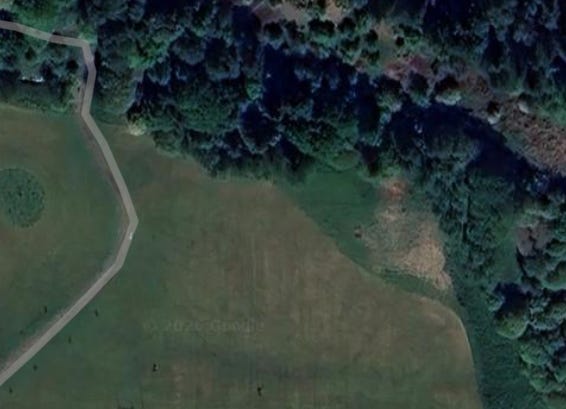
Here, we see a hard border between (mown) grass and a forested area. This is a very artificial thing. Forest-adapted species on the very edge are likely exposed to stressors they’re not built for, such as stronger wind and sun. What would be more ecologically sensible, and provide more habitat variety, would be to have a zone between the traditional park and the forest which has trees at lower density. Spaces for this exist on the borders of parks/gardens/farms and forests, and in currently-mown areas that aren’t great for human use (sloped or waterlogged).
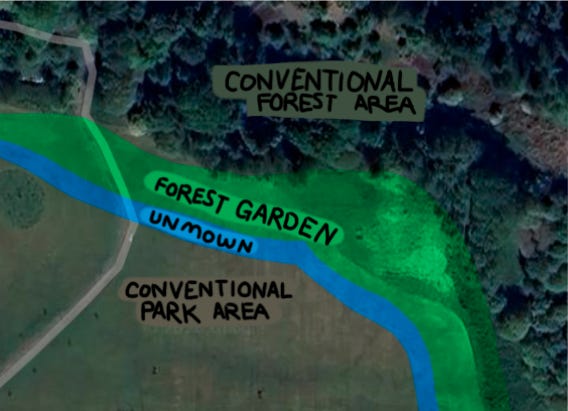
Above: where a “forager park” might fit into the landscape, softening the border between a conventional park and a forest. It would provide new land uses and new habitats on the local scale.
These “border spaces” are ideal for a “forager park.” Such an area could be maintained by a community by coppicing and pollarding to keep trees at a human-appropriate height. Trees would be planted further apart, making it easier to navigate and allowing sunlight to reach the ground, encouraging potentially-useful undergrowth to come in. The primary labour activities would be pollarding and coppicing, which only need to be done every few years, removing invasives, and keeping trails clear and the canopy open. These can be done as a community activity, something not possible with mowing grass. Foragers can go in and out as they please, and organise as a community to address issues and prevent overharvesting.
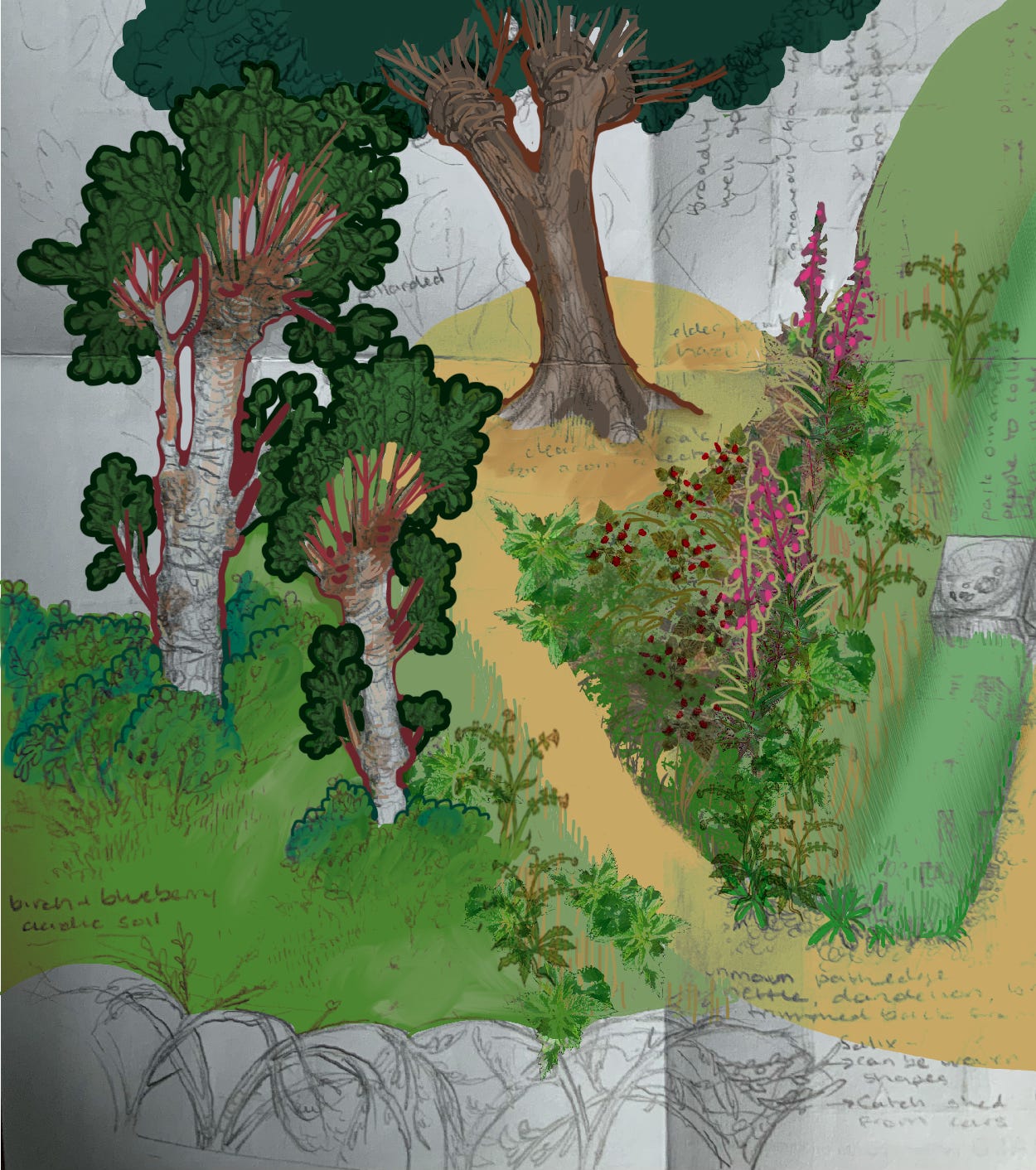
What might a forager park look like? To work through my thoughts, I sketched a landscape inspired by my research and by things I have seen in real life. Coppiced and pollarded trees keep the canopy open. Some trees can have undergrowth cleared around their base, so we can reach them easier – I think this would make sense for trees like oaks which drop nuts we can use. The area can be buffered from the traditional park uses using unmown stretches without woody plants, or by espaliered willow.
Above: a sketch of a forager park. Widely spaced trees kept trimmed to allow sunright to get through the canopy. Mown and unmown stretches provide a variety of habitats. Nettles and brambles are cleared from the path. Public art-infrastructure, such as a large bowl sculpture, encourages park-goers to collect fallen nuts and place them in the bowl.
As always, this is not a blueprint or a concrete set of instructions. This is best taken as inspiration, which can and should be heavily adapted to your own community’s circumstances.
If you don’t have a go-to group, then tackle what land-stewarding you can with your own hands (and don’t forget to talk to passers-by to get them on board). Turn your own yard into an informal public space, or if you are willing to take a risk, do what Macnith Community Garden did and just start using otherwise-unused space. If you have a group, you might have the means of formally (legally) moving land into common ownership, or to advocate for a forager park, or to fight for a local version of RESEX.
In any case, go out and get your hands dirty!
Thanks for reading. Before I go: if you’re in Scotland and want to see if we can get something going here, please email us (FAO Otto), or even better: why not post on our forum? I cannot receive DMs on my personal Substack.
Works cited
Barca, S. (2024). Workers of the Earth. Pluto Press.
Brown, I. F. (2001). Extractive Preserves and Participatory Research in as Factors in the Biogeochemistry of the Amazon Basin, in McClain, M. E., The Biogeochemistry of the Amazon Basin. Oxford University Press.
Pinzón Rueda, R., & Ruiz Murrieta, J. (1995). Extractive Reserves. IUCN - World Conservation Union.
Singh, N. M. (2013). The affective labor of growing forests and the becoming of environmental subjects: Rethinking environmentality in Odisha, India. Geoforum, 47, 189–198. https://doi.org/10.1016/j.geoforum.2013.01.010
Stark, P. B., Miller, D., Carlson, T. J., & Rasmussen de Vasquez, K. (2020). Open-source food: Nutrition, toxicology, and availability of wild edible greens in the East Bay. PLOS ONE, 15(9), e0239794. https://doi.org/10.1371/journal.pone.0202450
Vaarde, T. H. (2023). Social Forestry: Tending the Land as People of Place. Synergetic Press.
Nice! reminds me of a very old book I had: https://archive.org/details/collinsgemfoodfo0000mabe/mode/2up — Oh, you mentioned it already! But there is a borrowable web copy there...