


This is the third article in an 8-part series based on an essay by Ronan Murphy. The global economy runs on a simple logic. States must grow or be outcompeted, and those that fall behind lose their security. In a system where power still flows, ultimately, from the barrel of a gun, Ronan explores what this means for anyone hoping to build something different.
Part 1 (with a list of articles in the series) can be found here.
Even if internal inequalities are managed, a post-growth community must survive in a hostile environment in the short and medium terms in order to scale. Today’s world is dominated by nation states vying over sovereignty and great powers jockeying for resources and influence. The question then becomes, how does a sustainable experiment hold its own amid the realpolitik.
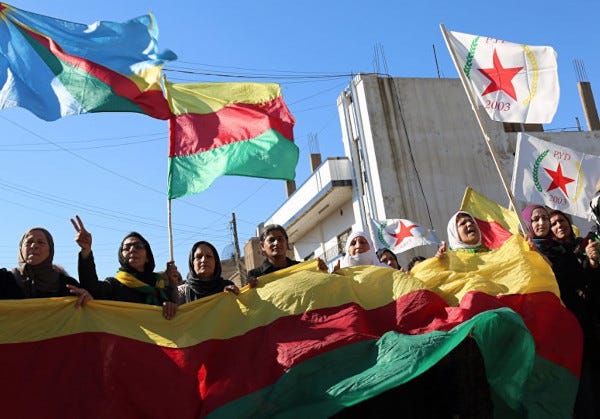
I, among many others exploring novel forms of alternative political economy over the last two decades, have been inspired by the experience of Rojava, the Kurdish-led autonomous region in northern Syria. Amid Syria’s civil war, the Kurds and their allies carved out a self-governed zone that rejected both Assad’s dictatorship and fundamentalism. What made Rojava particularly special was its embrace of decentralised governance (known as Democratic Confederalism), direct democracy, and feminist and ecological principles synthesised by Abdullah Öcalan. By 2017, an estimated 5 million people – Kurds, Arabs, Assyrians, Armenians, Yazidis and others – were living under Rojava’s system of communes and councils. Its constitution enshrined gender equality, ethnic inclusivity and grassroots decision-making, striving toward a post-state society beyond ethnic nationalism. It could be argued that Rojava attempted a form of post-Westphalian governance on a local scale, rejecting the nation state in favour of a confederation of communities, because the alternative did not represent their beliefs, interests, nor respect their lives.
Importantly, this revolution in regional governance was coupled with an ethic of ecological sustainability and cooperative economy, quite the departure from growth-driven development. The outcome was that citizens of Rojava broadly enjoyed a better quality of life than citizens in neighbouring states using traditional methods of development.
Rojava was a glimpse of a post-Westphalian future, with multi-ethnic coexistence, autonomy, and communal care for people and land.
Its decentralised structure proved resilient in several ways. Power distributed among neighbourhood communes created very strong social cohesion. During times of war against ISIS, Rojava’s model of ‘everyday democracy’ at the grassroots contributed directly to security. Communities, with intimate local knowledge, were able to root out extremist cells and maintain order from below. Women played leading roles in both civil society and defence, famously organising women’s protection units that not only fought ISIS but also transformed norms. This empowerment of previously marginalised groups built a powerful collective stake in the system that made it worth fighting for.
Moreover, Rojava carried ideological power on the world stage. By demonstrating a workable alternative to authoritarianism and fundamentalism it posed a threat to surrounding regimes by example. The success showed that ordinary people could govern themselves without a nation state, patriarchy or profit, an open challenge to the ideological hegemony of both dictators and imperialists.
Ultimately, however, Rojava also exposed the security gaps facing any progressive polity in a world of states. Despite its internal cohesion, Rojava had to navigate reliance on external actors. Its militias, the YPG and YPJ, received air support from the United States to defeat ISIS, tying them to great-power calculus.
When ISIS was defeated in 2017-2018, the Kurdish-led forces found themselves largely abandoned by Western allies and their agreements of necessity. Turkey, fearing a Kurdish autonomous region on its border and emboldened by global indifference, launched an invasion. In early 2018, Turkish forces and their proxies invaded the Rojava canton of Afrin, eventually occupying the territory. They carried out documented war crimes and ethnic cleansing, driving out hundreds of thousands of Kurdish inhabitants.
The world’s major powers largely looked the other way. Turkey is a NATO member and an important regional player. Rojava’s lack of formal statehood meant it had no protection under international law, no seat at negotiation tables, and no patron once it outlived its usefulness in the fight against ISIS. The harsh moral is that even the most enlightened communal society can be crushed by conventional force if it stands alone in the world as it exists now.
As of early this year, Rojava’s self-organised and semi-independent status no longer exists in a meaningful sense. The new Syrian government has begun the process of absorbing Rojava’s governance apparatus into its own, largely permitted by the US’ ambivalence towards its former ally, having previously described their partnership as “temporary, tactical and transactional”. Its survival up to now is a testament to resilience and solidarity, but its struggle is a reminder that security remains a precondition for sustaining progress.
There is also a second lesson that Rojava teaches about strategic positioning. Stuart Kauffman’s concept of the “adjacent possible” describes how complex systems evolve not by leaping to optimal states but by exploring neighbouring configurations that are reachable from where they currently stand.(1) Biological evolution works this way. So do technological revolutions. And so, arguably, do political transitions.
This is consistent with Ilya Prigogine’s own analysis - “When a complex system is far from equilibrium, small islands of coherence in a sea of chaos have the capacity to shift the entire system to a higher order”.
Rojava was not an adjacent possible, but it was an attempt to build a fundamentally different society at the point of highest impediment, surrounded by hostile state actors with overwhelming military superiority.
This suggests a different strategic orientation for post-growth experimentation. Rather than building at the sites of greatest resistance, alternatives should be tested and refined in adjacent landscapes where the same problems exist at lower intensity. Community energy projects in small towns, commons land and housing stewardship in peri-urban areas, or citizens assemblies in cities with sympathetic administrations. These are strategic rehearsals over compromises, for now. The knowledge, institutions, and relational infrastructure built in these spaces can be transferred, adapted, and scaled as conditions shift.
Frank Geels’ multi-level perspective on socio-technical transitions also offers a useful way of thinking about this.(2) Transitions happen when niche innovations build momentum at the margins while the dominant regime destabilises under landscape pressures (climate breakdown, resource constraints, legitimacy crises). The niches do not need to overthrow the regime head-on, but they do need to be ready when the dominant regime breaks, and connected enough to one another to fill the gap.
This is consistent with Milton Friedman’s famous “Only a crisis - actual or perceived - produces real change. When that crisis occurs, the actions that are taken depend on the ideas that are lying around. That, I believe, is our basic function: to develop alternatives to existing policies, to keep them alive and available until the politically impossible becomes the politically inevitable”.
In The Art of Not Being Governed, James C. Scott documents how decentralised, “illegible” communities across Southeast Asia resisted state absorption for centuries through dispersal, mobility, and the deliberate cultivation of social forms that states find difficult to penetrate or administer.(3) Seeing Like a State extends this, showing how centralised governance repeatedly fails when it cannot read or accommodate local complexity.(4)
The implication for post-growth enclaves is that survival may depend less on military parity and more on becoming the kind of community that is costly to absorb and difficult to govern from outside.
The conclusion from this section is that any future post-growth enclaves will face similar exposure unless the broader geopolitical context shifts in their favour. Decentralised autonomy can flourish against the odds, but without a way to deter aggressors they will be strangled. A sustainable transition must be complex, and ready to keep the political option for scaling ready until “the politically impossible becomes the politically inevitable”.
Notes
1. Kauffman, S. (2000). Investigations. Oxford: Oxford University Press. See also Kauffman, S. (1995). At Home in the Universe: The Search for the Laws of Self-Organization and Complexity. Oxford: Oxford University Press.
2. Geels, F.W. (2011). The multi-level perspective on sustainability transitions: Responses to seven criticisms. Environmental Innovation and Societal Transitions, 1(1), pp. 24-40.
3. Scott, J.C. (2009). The Art of Not Being Governed: An Anarchist History of Upland Southeast Asia. New Haven: Yale University Press.
4. Scott, J.C. (1998). Seeing Like a State: How Certain Schemes to Improve the Human Condition Have Failed. New Haven: Yale University Press.
Completely agree with this approach: let’s build ‘small islands of coherence’, start to connect them, and be ready when the dominant regime breaks.