


This text started out as a thread on X, after which its author Dil Green padded it out to serve as a response to Ann Pettifor’s Substack post ‘It is Time to Storm the Gates of Private Power’. We believe that it can stand as an article in its own right, which is why we are posting it in lightly edited form below.
For clarity, despite my position that spending time trying to get nation-states (and indeed any institutions of equivalent scale) to address the omnicrisis is a (bad) waste of time, I do strongly believe that they should be addressing it, and that this would be the best way.
I just know they cannot – not in any useful, effective or timely way. And thus working as an activist will be a waste of your effort at the most crucial point in all of human history.
Nation-states will not be effective in addressing the omnicrisis which faces the whole of humanity and the whole of the biosphere.
To be specific around 'cannot' and 'could': nation-states could do many things – they still have significant control around money and policy, and could bring democratic legitimacy to tough choices.
They cannot, because the workings of nation-states have been systematically enmeshed into finance capital, and because many of the individuals with apparent agency within them – both elected and unelected – have been suborned by bribes and/or cowed by threats.
This systematic enmeshing and bribery could imaginably be unpicked, but this condition took at least a century to evolve (it was not a coordinated plan), and is now effectively a-human. The people who are its avatars – Trumps, Lagardes, Putins – are not it, not in control; they just deliver it (messily – it is a complete mess).
Neither is there a 'class' interest in control: the Musks, Bezos, Cooks, Nadellas, Buffets are entirely its creatures.
All these people have indeed made the choice to work at proving themselves efficient agents of some niche of the system – why they often seem like lizard people. They have personal power beyond our imagining, but they are not personally strong – there are thousands of others urgently striving to be more lizard-like.
Remove one of them and ten more appear, eager to prove themselves worthy.
They conspire but do not constitute a conspiracy. They plan but do not have a masterplan. They coordinate but also sabotage each other.
The important, but hard thing to understand – when the past shows us individuals used to have agency, when the media continually tells us that they do have agency – is that these individuals are functionally interchangeable, personally irrelevant, despite the reality that they do important work for the system – that it needs them.
What the above means is that almost everyone who wants to change things at the nation-state layer is acting against their own aims.
I mean this literally.
Because this a-human system has no mind, no consciousness, no centre, only the kind of path dependency a Complex Adaptive System has – naively put, a will to survive (more accurately, an observable ability to act so as to ensure that its future is as compatible with its past as it can be) - this system is functionally able to learn, to adapt, to change itself.
In large part it finds out how to do this from its opposers – it needs and uses them.
There is one opposition group who believe that they ‘get’ (even own) the argument I just made (though they use other terms), and thus that they are beyond it.
These people believe that, by opposing it, they can ‘progress’ the system towards a more humane version: that, to put it crudely, ‘the only way out is through’ - that the system must be transformed by opposition, that no other historical path is possible.
This is wrong in two ways. Firstly, the idea that there is only one pathway for history is nonsense. But they will fight to the death over this and it's hard to prove because it's an ideology, so that it's handy that the second wrongness is incontrovertible and obvious: we don't have time.
Changing a system the scale of global finance capitalism, which has no centre, no class-consciousness – a system which actively and violently fights back while you are trying to change it, a system which adapts as if it were an evolving virus, a system which finds ways to adopt versions of the demands made on it by its opponents in ways which appease and co-opt them while strengthening itself… this is hard. Very, very hard.
Even if it's possible, even if you are happy to suffer (for millions of others to suffer, too), this takes historical time.
Which we ain't got. It's too late. Stage 4 cancer.
This historical path – the path of finance capitalism – is a self-terminating one (and big enough to delete civilisation with it, not to mention deal an enormous blow to the health of the biosphere).
No reform that could make a difference is achievable in time through any believable activist pathway.
Nation-states are fatally enmeshed in this historical path.
So meaningful, purposeful, wise action must not waste time or effort on any of that.
It must instead devote itself to another historical path which, far from being novel, is already present: the path which acts through life-like processes: the processes which delivered this species, which delivers our bodies, our minds; the systemic path which is also a-human, also a mess, also has no-one in control - but which, over more than 3 billion years, has proven not to be self-terminating, but to be self-expanding.
These are syntropic processes, where aspects of the system coordinate their actions to deliver emergent outcomes which grow the whole system in a viable way.
The system which, in human cultures, uses the pattern we know as commoning.
A pattern which is recognisable to all of us because, despite the powerful self-branding efforts of the finance system, it is still how human society functions.
The system upon which finance capitalism is most accurately (and I mean this quite technically) described as a cancer; using all the mechanics but seeking only to grow itself, ignoring the reality that in taking specific advantage of the syntropic mode – in which the main system operates for its cancerous growth – will kill its own environment and thus itself.
Yes, you are recognising this story: it is – directly – the story which Garret Hardin set out in his Tragedy of the Commons essay.
Every accusation is, of course, a confession: Hardin was an aspirant lizard, and his piece described anti-commons behaviour, claiming it was inevitable – to make an argument for privatisation (more food for the cancer). It's worth saying here that his tendentious claim has been definitively demolished by Nobel winner Elinor Ostrom, in great detail, with countless real-world examples plus theory to back it up.
From this perspective, the commoning mode path of history is the base environment which the cancerous mode lives on, not the ‘only path of historical progress’.
Thus our task is neither to fight the cancer (this only helps it evolve), nor to struggle to make it birth some new, healthier mode, but to simply step aside from it, and realise two things.
First, that commoning is already the way society works, where we spend most of our daily life coordinating our actions with other people so as to expand the scope of possibility.
That we are not 'all capitalists now'. Even in the corporate world, without people coordinating in a commoning mode (without institutional framing – indeed very often in spite of institutional framing), no meeting, no conversation, no project would work out.
That we have been conditioned to put our commoning mode into service of capitalism – or alternately to confine it to non-commercial activity.
That commoning is what comes naturally to humans.
And second, that we don't need to 'fight' the cancer (even if it were effective, we would have to fight all the forces the system can buy, plus all the aspirant lizards too - who are not truly evil, but, mostly, have just made poor choices in their attempt to live within an inhuman system: some sort of civil war or revolution would likely be needed; probably many of them - a terrible cost, destructively worsening the omnicrisis as a side effect).
We don't need to fight it, because we understand it. It is insanely complex – both internally and in its relations with human society – but its energy source, and its deep need, is incredibly simple, and incredibly dumb.
To survive, it has to continually increase the number of $ symbols in the system, on the basis of debt.
Knowing this, we can simply, carefully and deliberately starve it out; deny it what it needs most: people borrowing money (yes, simply that), for it to begin to wither and die.
We can design and grow commoning institutions which directly and specifically achieve this aim (more and more people borrowing less and less money) in entirely ethical and straightforward ways, through commoning – with all human participants in these commons getting a better deal from participation than they get from the system; where the only loser from the change is the finance system – where the change isn't weird or culty, doesn't need martyrs or saints.
These commons work in ways which (crucially) don't look to the system like an attack – indeed they are designed to look constructive at the overt (human-engaging) layers of the system. The intent here is to look 'normal' – to present any novelty as an incremental tweak to what is there which is designed for 'normal' people, not for radicals or special interest groups.
They can work in ways which can spread rapidly, both in numbers and impact, and which, by the time the system reacts at a deep level, will have real political strength and weight, and which will have transferred local infrastructure into commons control.
At some tipping point, the withering of the finance capital system will become a collapse, a realisation that all the $ signs in the world are just numbers in a database, and that they have lost credibility as claims on the value that humans build together.
It will be scary, as tipping points always are, but in and of itself the deletion of the power of the $ sign will do nothing to our ability to grow food, deliver energy and clean water, make things, use technology.
The only job the $ does (and does badly) is to act as a means of coordinating all those activities.
But through building and strengthening the cultural habits of commoning, through the development of the institutional forms of the new commons described already (and many more), we will find that we have already built a superior, more humane, more sustainable way of coordinating, and that it already covers the basics.
I could paint a rosy picture, but looking this far forward, who knows how it will really go?
And in any case, the system as a cancer is not our only problem.
Right at the top of this article I called it an omnicrisis, and the finance system is just the cause; it has already set the whole system of life on course for a violent and chaotic 'correction'.
Make no mistake: the system of life (which James Lovelock christened ‘Gaia’) will not be passive while a human artificial system acts in such a way as to materially degrade it. The finance system will be ended in any case, and relatively soon, by climate chaos.
My answer – and I hope to help you toward this – is because none of us are fine, right now, and things are getting worse.
Even if the worst comes true, it will take decades for climate chaos to really look as if our whole civilisation will be destroyed. Decades which we cannot describe in anything but the most hand-wavy way.
Decades we and our children and grandchildren will have to live through.
Decades which might even see some new way through.
It is very definitely worth making an effort for a medium term future where – locally at least (for commoning is first and foremost a local phenomenon, though it can encompass the new kinds of digitally enabled locality with ease) – things are getting better.
Where the yoke of debt-bondage and wage-slavery is easing off, where resilience of local infrastructure is increasingly in our own hands, where community has a material dimension to it as well as a purely social one (which is what keeps communities together in times of stress).
And when the effort required is mostly being willing to talk to our neighbours and colleagues more, about more substantive matters (not entirely a pleasure – new social muscles will need to be built), and the risks are being reduced by pioneers such as Stroud Commons (and many others), why would you not?
When the alternatives are:
Choice A: giving your life up to an endless struggle against an inhuman system which is dying anyway, and which will kill you without noticing, where winning looks like being co-opted.
Choice B: ignoring environmental degradation and deterioration of civil society and public infrastructure, accompanied by mounting inequality. Putting your head down and getting smaller every day.
Why would you not choose C: Commoning?
Oh! there is another option:
Choice L: becoming a lizard and saying everything is great - but inevitably becoming a Loser anyway.
It’s time to wind this short piece up with a simple, clear statement; a Call to Action:
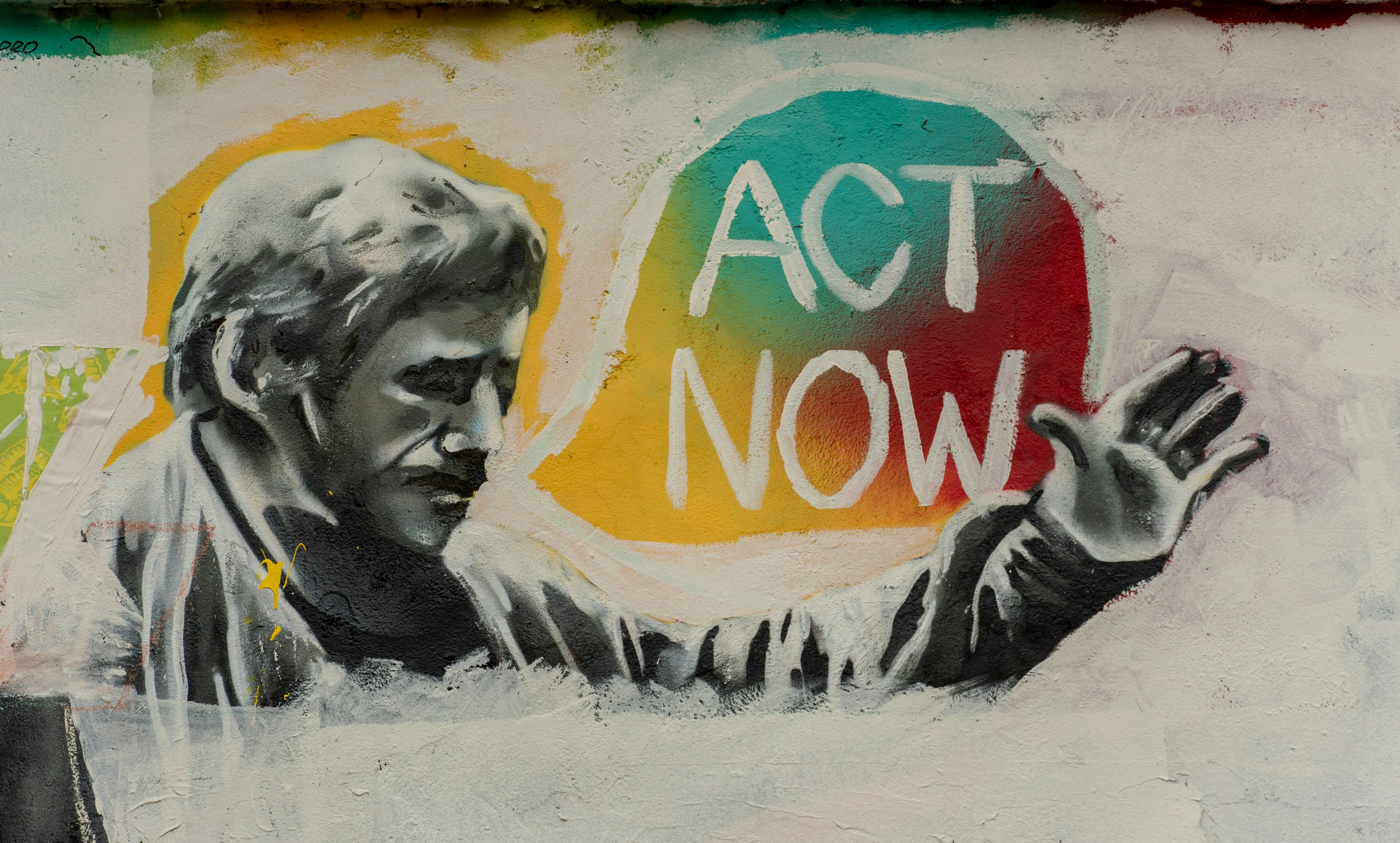
The action we need to take is to build commons, and, in the process, recover our birthright: the experience of living in material community as we discover that most of our daily life is – has always been – commoning.
Although I agree with all of this, I think building commons can be a form of activism. I think quite a few ‘activists’ (ie founders of XR etc) are starting to realise this. It would be great to direct the energy and fire of activism towards more practical matters.
I think you're right about the mechanism and wrong about the conclusion. The system has to keep increasing the number of $ signs on the basis of debt, that's exactly the diagnosis. But you can't starve it out from the commons, because the money system is itself a commons, and it's been enclosed.
Money is infrastructure. It's the unit of account for rents, taxes, wages, contracts, and court judgments. You can reduce your dependence at the margins, and commons do exactly that, which is valuable, but you cannot escape the unit of account while the rules that govern it remain in private hands. The Amish have lived in mutual aid, no-debt communities for centuries. They haven't starved finance capitalism; they've lived alongside it. That's not nothing, but it isn't the ending you're describing.
Which means the question isn't "build commons or do activism." It's what the activism is for. If it's for getting the state to fix things within the current money system, I think you're right that it's largely wasted effort. If it's for re-commoning the money system itself, making money a public utility, a public ledger, a public measure of value instead of a private debt instrument, then it isn't activism against the system. It's commons-building at the root.
The money commons was enclosed in 1694, in 1913, in 1971, and it's being enclosed again right now through tokenization and the UCC amendments. That enclosure is what forces every other commons to operate on debt-based terms. It's why your commons have to borrow to build, and why the interest on that borrowing is the thing that eventually eats them. Build all the commons you want; if the money they use is created as interest-bearing debt by private banks, they'll still be swimming in the same water.
So: yes to building the commons. And yes to the fight you say is a waste of time, because it isn't a fight, it's the same project. The commons needs a money commons. You can't starve the debt system without changing the rules that make debt the only game in town.