

Commons, not communism, part 3: how the 20th century almost turned out very differently
Why a commons world is not pie-in-the-sky

This is one of a series of 24 articles that I hope to compile into a book – working title, The Commoners’ Manifesto: Neither Capitalism nor Communism. Here’s an introduction to the series. Comments welcome, including disagreement and debate.
In the previous article I looked at the problems with communism, from a commons perspective, including historical materialism, seizing the state, growth and progress and the working class as the vehicle for change, whilst recognising that Marx sounded much more like a commoner in his later years.
In this article I want to argue that a decentralised, commons world isn’t pie in the sky, and actually, the world could have easily moved in that direction in the 20th century, rather than in a centralised, statist, world wars / cold war direction. Here are the main points I’ll cover:
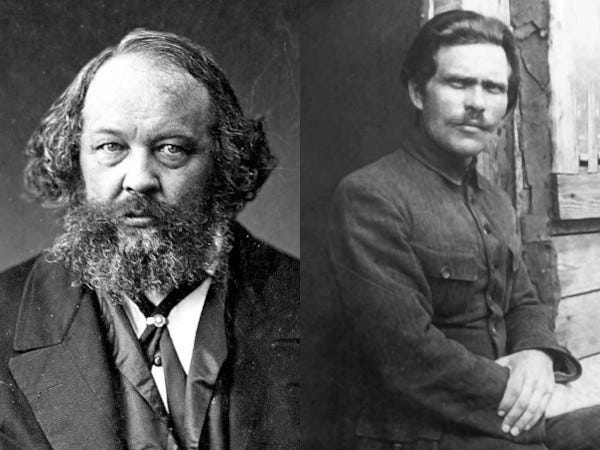
Bakunin and other anarchists challenged Marx’s ideas well before the Russian Revolution, and could have become dominant in the workers’ movement.
Anarchism and community-based initiatives were strong in Russia and Ukraine in 1917.
Between the February and October revolutions, workers took control of the factories, peasants the land, and community and workplace assemblies had a lot of power.
After the October Revolution, Bolsheviks crushed these decentralised movements.
But it was really close, and it could all have been very different. We could have taken a profoundly decentralised direction in the 20th century.
Bakunin and the Internationals
The ‘Internationals’ were four separate workers’ organisations at the end of the 19th and beginning of the 20th centuries, aiming to bring labour movements together globally in the same way that capitalism was internationalising.
The First International, 1864-1876, aka The International Working Men’s Association. This was the stage for the Marx vs Bakunin split (centralised socialism vs anarchism) that caused its collapse.
The Second International, 1889-1916, a federation of socialist and labour parties that broke apart during WW1 as, when push came to shove, nationalist sentiments trumped global solidarity.
The Third International, 1919-43, The Communist International (Comintern), started by Lenin to promote Russian-style communist revolution.
The Fourth International, 1938-present, started by Trotsky to oppose Stalin, only exists in fragments today.
I want to focus on the clash between Marx and Bakunin, which became the defining split in the First International, and finally tore it apart as Bakunin and his followers were expelled. We’ve talked a lot about Marx already. Let’s look at Bakunin, his arguments for anarchism and against Marxism, and whether he was right. Here’s an overview of the split, by a biographer of Marx, if you’re interested in the details, and below is my short summary.
Bakunin and Marx had an on-off relationship for 30 years, and respected each other. Although Bakunin described Marx as authoritarian, he also translated the Communist Manifesto into Russian. Their feud may or may not have been largely personal, but their attitudes to the state were very different. Bakunin saw the state not as a tool to be used, but a problem to be abolished. He argued for independent local communities, federated to get to scale, rather than a central state, which will always be captured by the most powerful groups in society, and used to maintain their power. He didn’t believe that workers could run the state, even temporarily, because if ‘workers’ get into positions of power (which isn’t likely), they stop working. And he certainly didn’t believe that the state would eventually ‘wither away’.
He believed that any authority should be temporary and voluntary. So for example, if a group of people found themselves on a boat in rough weather, and only one of them was an experienced sailor, they might decide to give authority to that person until they got safely to land again.
By many accounts, Bakunin wasn’t the nicest of people (and neither was Marx), but this isn’t about personalities, it’s about his predictions about what would happen if communists seize the state, which seem to me to have been correct. He said that the version of socialism proposed by Marx would mean that power is not transferred to the people but to the leaders of the communist party (Bakunin called them the ‘red bourgeoisie’).
He summarises his position nicely (in Statism and Anarchy, 1873): ‘The people will not be happier if the stick with which they are beaten is called ‘the people’s stick’’.
He was in favour of bringing together more aware people to ‘incite the latent instincts of the masses’. The internet makes it easier to bring aware people together, and I hope (and believe) that the latent instincts of the masses are towards commons, rather than centralised power.
Bakunin and the anarchists could have ‘won’ in the First International, which expanded quickly across Europe, but was hindered by language barriers, distances, slow communication and different legal restrictions in each country. So federal councils emerged to co-ordinate propaganda, organise congresses, manage membership disputes locally and translate and circulate resolutions.
The Basel congress in 1869 was the last really representative congress, before events in Europe (the Franco-Prussian war of 1870 and the Paris Commune of 1871 and its aftermath) made full congresses impossible. At that congress, according to Eugène Varlin, one of the International’s outstanding militants (who played a major role in the Paris Commune, and was executed for it), the position adopted almost unanimously by the delegates was collectivism, or non-authoritarian communism.
By the early 1870s, the movement was growing fastest in Spain, French-speaking Switzerland, Italy and Belgium, and in those places, a decentralised / federated approach dominated. The General Council in London and key northern European trade-union and socialist networks remained Marxist-controlled, but the balance of social and geographical strength within the International was shifting towards decentralised, anti-authoritarian socialism.
In Letters to a Frenchman on the Present Crisis (1870). Bakunin urged peasants to ‘take the land and throw out those landlords who live by the labour of others’ and to destroy state institutions through direct action, spreading ‘anarchy through the countryside’ (paraphrased from his 1870 writings). That’s exactly what did happen between the February and October revolutions of 1917 (see below), although of course it wasn’t because the peasants had read Bakunin!
A key event was the Paris Commune in 1871, just one year before the Bakuninists were expelled. It was claimed by both sides – as an example of the ‘dictatorship of the proletariat’ and of ‘anarchism in action’. Capitalists and their media blamed the International for the Commune, and indeed there were many International members involved. Marx wrote an address from the General Council praising the Commune. Bakunin claimed the commune had overthrown Marx’s ideas and accused him of hypocrisy.
The International’s support of the Commune made them enemies of all the governments of Europe and the bourgeois press. Although state repression usually hits centralised structures first, because there are identifiable leaders, physical headquarters etc., and local cells are harder to find and eliminate, it still caused problems for the anarchists because long-distance communication became harder and co-ordination costs rose faster than decentralisation capacity. The General Council was located in London, outside the main zones of repression, and so overall, anarchists were hurt more than Marxists.
After the Commune was defeated, Bakunin celebrated the fact that it had raised workers’ hopes of real change, outside of the state. Marx came to a different conclusion: for him, the defeat demonstrated the necessity for working-class political parties whose purpose would be the ‘conquest of political power’. Marx and Engels manipulated the composition of the Hague Congress in 1872 to ensure a majority that would affirm the London Conference resolution on political action, expel Bakunin and his associates and transfer the General Council to New York to prevent European anti-authoritarians from challenging their control.
Bakunin was accused of various skullduggeries including setting up secret alliances. But even Mehring (a Marxist), in Karl Marx: His Life, said that there was no evidence, and that Bakunin was trustworthy.
Bakunin and his followers formed their own decentralised movement (the St. Imier International), but both groups dissolved soon after. Anarchists weren’t allowed in the Second International.
None of this was inevitable. The outcome of the Hague Congress in 1872 didn’t reflect a clear ideological majority, but rather the ability of the Marxist leadership to leverage the International’s centralised institutional structure to discipline and expel its rivals. This approach wasn’t available to the anarchists, because of ideological opposition to centralised structures!
Anarchists weren’t fringe – they were a rival pole. Bakunin’s position was approved by the 1869 congress, was gaining ground across key regions of the International, and might have become the dominant tendency, but the institutional structure of the International - and the anarchists’ own anti-centralist principles – made it extremely difficult for them to convert that momentum into organisational control, as did events and the responses to them. In even slightly different circumstances, the main current of anti-capitalism by the time of the Russian Revolution might well have been decentralised / anarchist.
While an anarchist International would not have guaranteed an anarchist Russian Revolution, it could plausibly have shifted the balance of strategic and institutional resources away from highly centralised party models and thereby opened a broader range of revolutionary outcomes in 1917.
I’m not saying any of this was likely – just possible. A decentralised / commons world is no less likely than the communist revolutions of the 20th century. It depends on events, the right people at the right place and time, hard work, and some luck.
Today, with the internet, it’s not so difficult to maintain national federations speaking different languages. The decentralised approach is much more achievable today, and local and national federations can speak to each other without going through a central hub. It’s still easy to imagine state crackdowns on anti-capitalist organisation, but today, centralised control would be a disadvantage, as it’s easier to shut down.
Anarchism and commons
Let’s look at the A-word. To many (probably most) it denotes chaos - and those in power have benefited from that. But it means the exact opposite. I’ll cover this more in a later article, but anarchism means decentralising power through negotiation and highly-ordered, non-hierarchical organisation, with decision-making covering larger geographical areas via confederation.
Bakunin didn’t help, by writing (in The Reaction in Germany), that ‘the passion for destruction is at the same time a creative passion’. While it is often cited by anarchists as a guide to action, Bakunin wasn’t outlining tactics or gesturing towards violence; he was writing as a Hegelian, not an anarchist. In Hegelianism, ‘destruction’ means the negation of an existing order as part of the process by which a new one comes into being - not chaos for its own sake.
Controversial I know, but I’d argue that ultimately, there are just 4 system-based philosophies: capitalism (ranging from neoliberalism to social democracy), communism, anarchism and fascism. Various lenses straddle those philosophies, like feminism or environmentalism. There are feminist capitalists and communists, and environmentalist anarchists and fascists (the Nazis were environmentalists).
Anarchism is a state of mind – a belief that people are basically good, but that power corrupts. People practice it all the time - in families, among friends, in clubs, informal and even formal gatherings or work. But there’s so much anarchist literature, often contradictory, and split into so many different threads (there wasn’t a central figure like Marx) that it needs some thinking about. There are lots of ways to do it, not one rigid ideology / set of rules. I identify 3 main threads though:
Mutualist anarchism (follows Proudhon): gradualist rather than revolutionary; distribution via markets, but no bosses, landlords or shareholders - no making money from anybody else’s work or from usury. Private property is fine as long as you live in it (housing) or use it for your work (workshops / land).
Collectivist anarchism (Bakunin): requires revolution; involves collectivisation of the means of production (land, industry, buildings, machinery); distribution is planned socially rather than through exchange.
Communist anarchism (Kropotkin): revolution; people take what they need from communal stores; from each according to ability, to each according to need.
Here’s an infographic (not mine – I stole it from somewhere years ago) on the differences between strands of anarchism (leaves out collectivist anarchism, harsh on anarcho-primitivism but spot on about ‘anarcho-capitalism’):
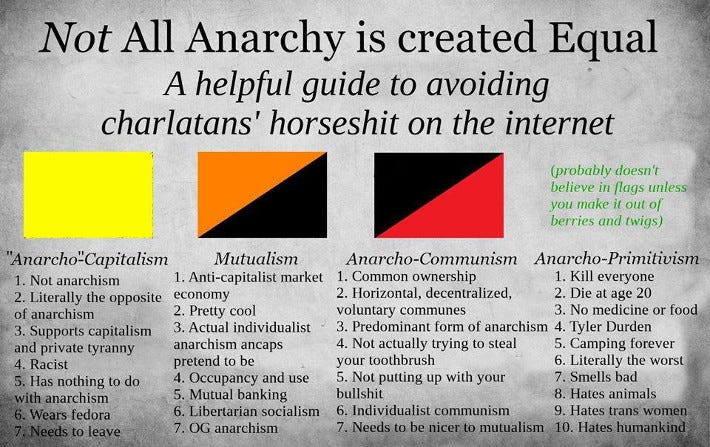
If you want to go deeper, An Anarchist FAQ is a huge resource.
Commons is, I believe, a flavour (or building block) of anarchism – the mutualist flavour, to be specific. That doesn’t mean that it can’t evolve into something else (that doesn’t involve markets for example), but I can imagine it growing, in the cracks in capitalism, whereas I don’t see a viable route to the other two from where we are.
Anyone interested in commons is unlikely to be neoliberal or fascist, so arguing against them would just waste time. I’ve already argued against the communist approach from a commons perspective, and in future articles I’ll argue that the centre-left / social democrat approach is capitalism with (some) rough edges removed, and it won’t challenge corporations or deliver the scale of change we need.
Communist writers dismiss anarchism. For example, here: ‘Anarchism is appealing to many young people due to its simplicity: to reject anything and everything to do with the status quo. But upon deeper examination, there is a pervasive lack of real substance and depth of analysis in these ideas. Above all, there is very little in the way of an actually viable solution to the crisis of capitalism.’ (the rest of the article continues to patronise, and to demonstrate that he doesn’t understand anarchism).
Those not familiar with anarchist ideas see that anarchists and right-libertarians oppose the state, and often conflate them. Actually, the words libertarian and anarchist were virtually synonymous in the 19th century. The right captured the word libertarian after WW2, some calling it anarcho-capitalism (an oxymoron if there ever was one), but some anarchists use the term left libertarian to describe themselves (although I’d prefer to drop left and right labels altogether, and just use the term anarchism. We’ll go into this more in the ‘decentralisation’ article, later, but the big difference between anarchists and (right) libertarians is their attitude towards capitalism. Libertarianism is nowadays a cover for vested interests, who want less regulation of their own industry. They want a small state until they squeal to be bailed out when they’re in trouble. Right libertarians denounce the state and champion capitalism. But capitalism can’t exist without the state, so right libertarianism is an oxymoron. Anarchists denounce the state and capitalists, as partners in centralising power.
And libertarians view society as consisting of nuclear families, individuals and businesses. They don’t include co-operation or commoning. Anarchists do.
But who needs -isms? We can just build commons. If you want to study anarchist theory as well, great. But it’s not necessary in the way that Marxist theory is necessary to understand and apply Marx’s ideas. Anarchism has been largely theoretical for a long time, at least in the West. Rojava is an exceptional example further east, but threatened now by developments in West Asia.
Decentralisation of power in 1917
Events in Russia in 1917 shaped the 20th century, led to millions of deaths, untold suffering, and cold and hot wars. It could have been very different.
First, a bit of history. Serfdom didn’t end in Russia until 1861. Serfs were then legally free, but land was still owned by the nobility. Serfs were given allotment land that they had to reimburse the nobility for. The growing season in Russia is very short, and peasants couldn’t generate the surplus to pay the debt.
There was a revolution in 1905 – peasants rose up, burned many nobles’ manor houses and took the land under the ownership of the mir (village commune).
By 1917, WW1 was causing food shortages and breakdown in the Tsarist system. Anarchist ideas were spreading, especially in Ukraine, where Nestor Makhno was active in underground revolutionary circles that eventually developed into a large peasant-based insurgent movement that established zones of anarchist self-organisation. Anarchists played a part in the revolution, and in some regions helped defeat the ‘Whites’ (counter-revolutionary forces, including Tsarists).
There were actually two revolutions in 1917 – in February and in October. The February Revolution was a popular uprising that removed the Tsar, but the October Revolution was a Bolshevik military coup. Isaiah Berlin witnessed both of them. For him, the dominant feeling in the first was excitement, and in the second, fear (Michael Ignatieff, Isaiah Berlin: A Life and Isaiah Berlin, Russian Thinkers).
From a commons perspective, there were some very interesting developments between the revolutions of 1917. Peasants seized and redistributed land among themselves, and workers formed factory committees to run industries. This was a massive, decentralized social revolution from below. Sheila Fitzpatrick’s The Russian Revolution (1982) gives a good overview.
Many soviets appeared – locally elected councils, or ‘citizens’ assemblies’ (in towns, workplaces and army barracks), in parallel with but not controlled by national government. First formed in the 1905 revolution, soviets were crushed by the state, but re-emerged in February, 1917. Co-ops also expanded rapidly.
It seemed that actual workers had a different conception of ‘worker control’ from that of the Bolsheviks. Maurice Brinton (The Bolsheviks and Workers’ Control, 1917 to 1921) gives a detailed chronology of the development of popular structures in Russia after the February Revolution, then describes the Bolsheviks’ steps to undermine and destroy them after they gained power in the October Revolution (see below).
He said that by September there were national conferences of factory committees (All-Russian Factory Committee Congresses) that managed production in those factories. It was all looking very commons-like.
Bolsheviks re-centralise power
The Bolsheviks, especially Lenin, didn’t want a decentralized system. They believed in a vanguard party that would seize state power and use it to guide society towards communism (Lenin, What Is To Be Done?, 1902). They saw worker control as ‘syndicalist nonsense’ and peasant landholding as backward. They were disciplined, organized, and utterly ruthless in their pursuit of a monolithic state.
They gained influence in the soviets, especially the big ones in St Petersburg and Moscow. Lenin argued for direct seizure of power. Trotsky co-ordinated military forces loyal to the Bolsheviks, who easily took the Winter Palace (the imperial residence of the tsars, which was then housing the provisional government – the post-tsarist administration). There was an election immediately afterwards, which the Bolsheviks lost (but they dissolved the assembly and took power anyway).
But Peasants, workers and soldiers didn’t want centralised power, so the Bolsheviks indulged them at first, and got them onside by talking about how they’d got rid of the fur coats, fancy restaurants and mansions of the rich. This neutralised attempts by other groups (and there were many) to take centralised power off them. They crushed the independent factory committees, replacing them with state-appointed managers, forcibly requisitioned grain from peasants, leading to famine, and suppressed anarchist groups in Moscow, St Petersburg and Ukraine.
Emma Goldman, who lived in the Soviet Union for 2 years following the October Revolution, said (in My Disillusionment in Russia): ‘As soon as the Communist Party felt itself sufficiently strong in the government saddle, it began to limit the scope of popular activity. All independent organizations... were either subordinated to the needs of the new state or destroyed altogether, as were the soviets, the trade unions and the co-operatives – three great factors for the realization of the hopes of the Revolution.’
Maurice Brinton, in The Bolsheviks and Workers’ Control, 1917 to 1921, said that even before the October Revolution, Bolsheviks had started infiltrating factory committees with a view to making them subservient to the party. After gaining power, they started to dismantle the factory committee system.
Civil war followed (1918-21), which allowed the Bolsheviks to consolidate power using emergency wartime measures, expansion of the Red Army and secret police, and state terror.
‘Soviet Union’ implies a network of nested citizens’ assemblies, from neighbourhoods up to the national level. The Bolsheviks destroyed that idea, and enforced centralised control via the Communist Party. Soviets weren’t allowed any decision-making powers – only rubber-stamping the state’s decisions.
Sheila Fitzpatrick (in The Russian Revolution) noted similarities between communist collectivisation of land / rapid industrialisation in Russia and earlier enclosures and capitalist industrialisation in the West – both pushed peasant farmers off their land and into cities / factories.
Communists often denounce Stalin, but the Soviet Union was authoritarian well before Stalin became uncontested leader in 1928.
But it was really close
It really wasn’t inevitable that the Bolsheviks seized power in the October Revolution, or that they managed to keep it afterwards. They did it by the skin of their teeth. They never had majority support, couldn’t get elected nationally, and almost collapsed several times. They got power via a coup – that could easily have failed. They then held an election, lost heavily, and had to send in the Red Guards to close down the assembly.
Several factors helped the Bolsheviks. The provisional government was weak – after the February Revolution, authority was split between the government and the St Petersburg Soviet. The Soviet had real influence over workers and, crucially, soldiers. This ‘dual power’ meant the government couldn’t reliably enforce its decisions – orders could be ignored if the Soviet disagreed.
Led initially by figures like Alexander Kerensky (later prime minister), the government chose to continue fighting in World War 1. That was deeply unpopular: the army was exhausted, desertion was rising, and civilians faced shortages. Every failed offensive further destroyed its credibility.
Peasants wanted land redistribution immediately. The government delayed it, but peasants just started seizing land anyway – undermining the government’s authority in the countryside.
It was an interim body, not elected. It kept postponing elections, which made it look illegitimate – especially when more radical groups like the Bolsheviks were offering immediate solutions.
It mishandled crises – notably the ‘Kornilov Affair’. In August 1917, General Lavr Kornilov appeared to move troops toward St Petersburg, to impose order. Kerensky panicked and armed workers (including Bolsheviks) to defend the capital. This backfired: it strengthened the Bolsheviks while making the government look weak and unreliable. The government ended up alienating almost everyone. Liberals thought it was too weak, conservatives thought it had lost control, workers wanted more radical change, peasants wanted land, soldiers wanted peace. It was trying to fight a war, build a democracy, and contain a social revolution simultaneously, without real authority over the army or the streets. That made it fragile, and the Bolsheviks were able to exploit that fragility. They managed to get a large section of sailors and soldiers on board, with promises of ‘all power to the soviets’, gaining support for expectations that never materialised.
Workers and peasants could have maintained their control over industry and agriculture if factions within the Bolshevik movement (libertarian Marxists and others) had gained more power, and if there’d been a more unified anti-Bolshevik front (involving anarchist, Menshevik and Socialist-Revolutionaries), that could have still won the civil war. None of this was impossible.
And finally, the Kronstadt Rebellion could have succeeded (soldiers and sailors rose up with the slogan: ‘soviets without Bolsheviks’), although it wouldn’t have been necessary if the Bolsheviks had failed in 1917.
The point I’m trying to make is that there was a big slice of luck involved in the Bolshevik victory, in very slightly different circumstances, they could have lost, and that those different circumstances weren’t at all outlandish.
Some historians, such as Orlando Figes (A People’s Tragedy: The Russian Revolution 1891–1924) and Richard Pipes (The Russian Revolution), argue that the outcome of 1917 was highly contingent and that the Bolshevik seizure of power wasn’t inevitable. Democratic alternatives existed, including soviet-based or decentralised systems. Noam Chomsky also emphasised the suppression of more libertarian socialist possibilities in the revolutionary period.
The 20th century could have been very different
Many Western leftists disbelieved or downplayed atrocities being carried out in the Soviet Union. George Bernard Shaw visited Russia in 1931, met Stalin and came back praising him. The position of many anti-capitalists was, more-or-less: ‘Wow, the Bolsheviks have pulled off a revolution! They may be a little authoritarian, but… they’ve pulled off a revolution!!!’ Revolutionaries all over the world were impressed. Anarchism declined, into a sideshow.
But just imagine what could have happened if the Bolsheviks hadn’t won. I’ll describe a few potential outcomes –- a global domino effect that’s pure speculation of course, but not complete fantasy. The fact that these things didn’t happen was largely down to the power of an authoritarian ‘Soviet Union’. In chronological order:
Russia and Ukraine, 1920s: power resides in democratic soviets; anarchists are not crushed or expelled; workers and peasants maintain control of factories and farms. With a friendly Russian ‘centre’ (or lack thereof), the Makhnovists would likely have survived and consolidated their hold in Ukraine, holding on to their territory and creating a powerful anarchist beacon.
Spain, 1930s: the anarchists of the CNT-FAI – the biggest workers’ organisation in Spain – prevented a fascist victory at the beginning of the civil war, took control of Barcelona and collectivized industry and land in Catalonia and Aragon. They were weakened by a lack of international support, and the USSR actively opposed them via support for the Communist Party (see Orwell, Homage to Catalonia, 1938). An anarchist Russia (a true ‘soviet union’) would almost certainly have provided the CNT-FAI with the resources and legitimacy they needed, potentially tipping the balance in their favour.
Eastern Europe, 1920s-40s: between the world wars, peasant parties held power across Eastern Europe. Land ownership was based on smallholdings, and they were trying to develop small-scale industry scattered among the farms, producing things for each other. This was the opposite of the Soviet approach – large-scale agriculture and industry – so although they were fighting fascists, the Soviets didn’t take their side. They could have combined to suppress fascism, but didn’t, and so by 1939, all peasant governments except the Czechs’ had gone. (see David Mitrany, Marx Against the Peasants). After the war, instead of being forced into the rigid, Stalinist model of the USSR, the Eastern Bloc countries could have developed their own, decentralised forms of socialism, potentially influenced by a decentralised Russia.
China, 1940s: the influence on Mao’s Chinese Communist Revolution is more speculative, but a different model of libertarian socialism dominating the global left would certainly have been a major factor. It might have provided an alternative to the rigid Stalinism that Mao often emulated.
Korea, Cuba, Vietnam, 1950s-70s: there might have been anarchist revolutions, rather than communist ones, which could have influenced other countries in the Global South.
It’s conceivable that we might have had a largely anarchist world in the 20th century, especially in the Global South. I’m not saying it was likely – just not impossible. A decentralised, commons or commons-like world would be even more possible now, with global support, new technology, no Soviet Union and the US in decline.
Conclusion
There are lots of ‘what-ifs’ in this article, but I just want to show that the Russian Revolution could have produced a decentralised, commons-like challenge to capitalism in the 20th century. It’s speculative, but not crazy, I don’t think.
Capitalism suppresses commons via extraction, communism via forced collectivisation and crushing civil society. Communism is far from dead, and it’s often seen as the only real alternative to capitalism. I want to persuade anti-caps on the cusp of communism that there’s an anti-authoritarian, sustainable and achievable alternative.
Communists and capitalists can be members of the commons (as customers, investors or employees, all of whom are full members with democratic rights). Capitalists will find it hard to dismantle a system that brings benefits to many people, but where communists are able to seize power, I think they’ll probably suppress commons. Both left and right have created barriers for the commons, historically. Capitalism and communism create their own elites, with concentrated power that makes real democracy impossible. Commons does the opposite.
Communism couldn’t compete with capitalism – Hayek was right about planning. Also, in the 60s, the Americans and Soviets built proto-internets, but the Soviets closed theirs, because the communist party feared it would challenge centralised power. Big mistake. It was the thing that could have saved them. Without it, the massive bureaucracy involved in running a giant planned economy was impossible. By the time Gorbachev was implementing his reforms, the whole Soviet system was collapsing.
That doesn’t mean we have to have a capitalist world. Capitalism is disastrous for nature, democracy and community. Communism was tried extensively as a solution in the 20th century, and actually made things worse. A non-capitalist, non-communist world is possible – systems don’t last forever. It’s time for a new approach for anti-capitalists – the commons approach. Build a better system from within capitalism, and transition to it. Marx was writing in 1844, when groups of people in Rochdale were starting to build the co-operative movement. That was a much more promising movement than communism or reform of the state.
But here we are, with capitalism still dominant, although looking more fragile than previously. 100 years ago, workers, peasants and anarchists struggled to co-ordinate and communicate at scale. We now have the internet and new tools / models to make it happen, that I’ll cover in more detail in upcoming articles.
Attempts at decentralised, non-hierarchical, truly democratic organisation keep surfacing, and they’re not going to stop. In the previous two articles, I tried to point out that Marx’s critique of capitalism was good, but communism in practice wasn’t, and in this article, that a commons / decentralised world isn’t pie-in-the-sky.
So far, I’ve tried to persuade anti-caps not to take the communist route. In the next few articles I’ll explain why I don’t believe the electoral route will work either, because states are captured and serve corporate interests.
Ви надто перебільшуєте владу і силу Махновщини. Вона була сформована, виключно через причини слабкості централізованих систем.
Справжня анархія не визнає жодної влади: ні більшості, ні меншості, ні обʼєднань чи утворень. Всі союзи чи обʼєднання мінливі і тримаються виключно на особистій зацікавленості/вигоді/перевагах.
В анархістській ідеології, передбачається, що людина буде діяти так, але не інакше, в деякій мірі навіть страждаючи заради збереження якогось принципу си переконань. Якщо ця ідеологія навʼязана си не прийнята як ВІРА, нічкого пнархізму навіть в невеликому колі бути не може. Ніхто не знає як би він діяв і якітрвшення приймав. Слова і описи це не реальні дії. Анархія ігнорує спільне. Анархія це антитеза спільному. Якщо ви пишете про «народ», «робітників» та «спільне», ви пишете не про анархію. А про демократію та пряму участь більшості. Анархія це інше. Анархіста рухає бажання справедливості(щодо нього чи його бачення), вигоди та індивідуальних бачень та принципів. Будь які великі обʼєднання людей неминуче будуть стикатися з узурпацією влади, ієрархією та накопиченнями благ. Лише нестабільні умови(клімат як приклад), які повсякчас руйнуватимуть будь які можливості до великих обʼєднань, зможуть повернути «природний» стан людських популяцій — родо-племінні групи мисливців збирачів.